Nigeria is often described through its divisions. Muslim north and Christian south, Hausa and Fulani, farmer and herder, indigenous and settler, one political party against another—the categories pile up until more than 200 million individual human beings begin to disappear behind them.
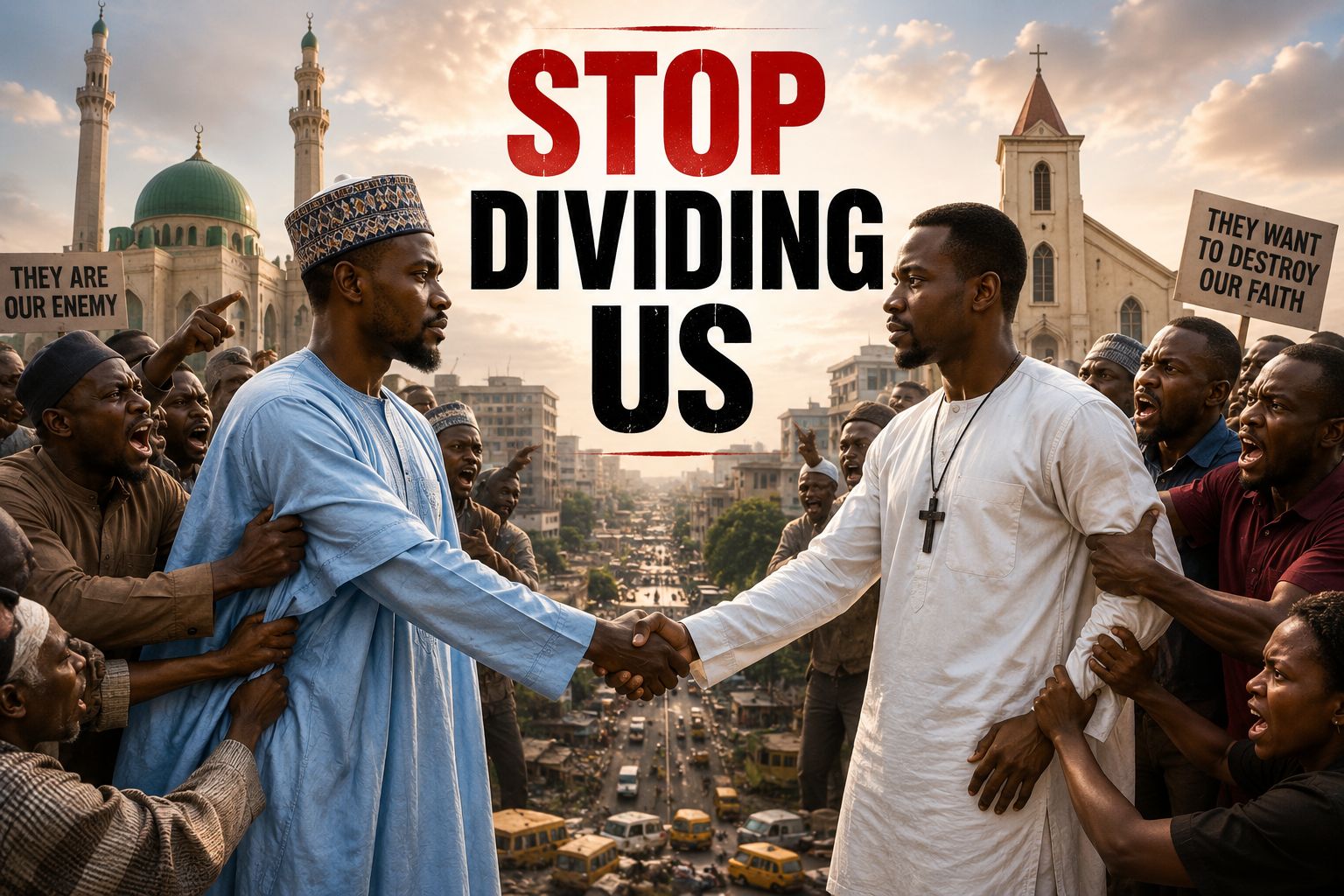
Something rather different happened in Abuja on August 12. More than 50 prominent Muslim and Christian leaders signed an interfaith peace accord and launched a new body intended to promote religious harmony across Nigeria. The gathering, organized by the Saudi-based Muslim World League, brought together religious leaders who emphasized cooperation, opposition to extremism and rejection of inflammatory rhetoric.
It should not sound revolutionary. Yet in a country where religious identity can become entangled with terrorism, ethnic conflict, electoral politics and misinformation, publicly declaring that Muslims and Christians should cooperate rather than fear one another is considerably more important than it ought to be.
Nigeria does not need another identity war
Nigeria’s religious landscape is complicated, but its broad geographical divide is familiar. Its population of more than 200 million is roughly divided between a predominantly Muslim north and a largely Christian south, alongside traditional religions and other beliefs.
Religion, however, rarely operates alone. Ethnicity, geography, poverty, competition over land, organized crime, political power and historical grievances can overlap with religious identity, producing conflicts that cannot honestly be reduced to Christians versus Muslims. Nevertheless, that simple explanation is exceptionally attractive because complicated problems are difficult to sell and easy enemies are not.
A Christian is killed, and someone presents the death as proof that Muslims are coming for Christians. A Muslim is killed, and another community can construct its own collective narrative. When a criminal happens to belong to a particular ethnic or religious group, millions of completely unrelated people may suddenly find themselves rhetorically placed in the defendant’s chair.
This is tribalism’s favorite trick. Take an atrocity committed by identifiable people, expand responsibility outward until it encompasses an entire population, and then persuade ordinary people that somebody they have never met is their enemy.
Extremism has harmed Muslims and Christians
The new accord is particularly significant against the background of Islamist violence. Boko Haram and Islamic State West Africa Province have inflicted enormous suffering during more than 15 years of insurgency, and Christians have unquestionably been among their victims.
Yet the story becomes badly distorted when Islamist terrorism in Nigeria is presented simply as Muslims attacking Christians. Reuters reports that analysts and human-rights groups say the vast majority of victims of Islamist insurgencies have been Muslims, with much of the violence concentrated in the predominantly Muslim northeast.
That reality should not minimize the murder of Christians. Instead, it demonstrates why collective religious blame is so intellectually and morally disastrous: Muslim civilians can simultaneously be members of the religion invoked by extremists and victims of those same extremists.
A terrorist does not speak for the Muslim shopkeeper he murders, nor does he represent the Muslim mother whose child is killed. Likewise, he does not speak for the Muslim cleric who condemns him or the millions of ordinary Muslims trying to live normal lives.
The principle must work in every direction. A Christian extremist does not represent Christians, a Jewish extremist does not represent Jews, and a Hindu extremist does not represent Hindus. Responsibility belongs to perpetrators, organizations and those who knowingly support their crimes—not to everyone who happens to share some aspect of their identity.
You do not have to abandon your religion
One of the most important messages to emerge from the Abuja gathering is that cooperation does not require theological surrender. Muslim World League Secretary-General Mohammad Al-Issa emphasized the damage caused by extremism, while Nigerian Muslim and Christian representatives stressed unity and the need to combat hate speech. (Reuters)
That distinction should be obvious, yet it is frequently lost in polarized discussions. A Christian can remain completely convinced that Christianity is true, while a Muslim can remain equally convinced that Islam is true; an atheist can conclude that both are mistaken. None of them needs to settle that argument before agreeing not to kill, persecute or discriminate against the others.
They can also cooperate on practically everything required to make a society function. Muslims and Christians do not need theological agreement to build hospitals, educate children, reduce poverty, fight corruption or make neighborhoods safer.
Pluralism does not mean pretending differences do not exist. It means creating a society capable of surviving those differences.
Nigeria has done this before
The Abuja accord should not be presented as the moment Nigerian Muslims and Christians suddenly discovered interfaith dialogue. Nigeria has a long history of religious leaders trying to bridge the divide, sometimes under extraordinarily difficult circumstances.
Among the best-known examples are Pastor James Wuye and Imam Muhammad Ashafa, former adversaries who became prominent interfaith peacebuilders in Kaduna. Their Interfaith Mediation Center has worked with young people, women, politicians and religious leaders while contributing to local peace initiatives.
That history makes the latest accord simultaneously encouraging and sobering. Nigeria does not suffer from a shortage of declarations that peace is preferable to violence; the difficult part has always been translating declarations by leaders into behavior throughout society.
Signing a document in Abuja takes hours. Changing how communities react when people have just been murdered can take generations.
That is where the real test begins.
The next attack will test the accord
Imagine another village is attacked tomorrow. Bodies are discovered, frightened survivors begin talking, unverified accounts spread across social media, and somebody identifies the alleged perpetrators by religion or ethnicity.
That is precisely the moment when peacebuilding matters.
Will politicians wait for evidence, or will they exploit the deaths? Will religious leaders calm their followers, or will they tell them that their faith is under attack? And will journalists identify actual perpetrators and armed organizations, or will an entire ethnic or religious community appear in the headline?
Social media presents another challenge. A false allegation can travel across Nigeria long before investigators establish what actually happened, while an old video from another country can be reposted as evidence of a supposedly new atrocity.
Peace accords cannot eliminate these forces. Religious leaders can, however, make it considerably harder for extremists to persuade people that murdering their neighbors constitutes defense of their community.
Religion is not the only division
Nigeria’s conflicts become even more difficult to understand because religious and ethnic categories overlap imperfectly. Not every northerner is Muslim, not every southerner is Christian, and neither Christianity nor Islam constitutes a single political community.
The same warning applies to ethnic identity. Fulani communities, for example, include pastoralists, farmers, professionals, urban residents and people living across numerous West and Central African countries. Treating an ethnic group as synonymous with banditry because some armed perpetrators are Fulani turns criminal investigation into collective suspicion.
Once people learn to think this way, division becomes self-reinforcing. Violence produces fear, fear produces stereotyping, stereotyping produces retaliation, and retaliation provides the next generation with another atrocity to remember.
Someone eventually has to interrupt the cycle.
Muslim and Christian leaders publicly standing together will not accomplish that by itself. It can nevertheless tell their followers something essential: the person praying differently from you is not automatically your enemy.
Politics makes division useful
There is another reason to pay attention to the timing. Nigeria is moving toward its January 2027 presidential election, and religious representation remains politically sensitive, including controversy surrounding the governing party’s Muslim-Muslim presidential ticket.
Nigeria’s tradition of balancing religious identities in national politics developed for understandable reasons. In a country containing enormous Christian and Muslim populations, symbolic inclusion can reassure citizens that the government does not belong exclusively to the other community.
Yet there is also something depressing about needing religious arithmetic to establish political legitimacy. In an ideal democracy, a competent Muslim president should protect Christians, a competent Christian president should protect Muslims, and a president without any religious belief should protect both.
Citizens should not need somebody from their own religious group in power before they can expect equal treatment.
That principle is much easier to state than to achieve. Political entrepreneurs everywhere understand that identity can be converted into votes, especially when citizens feel insecure.
Give people an enemy and they may stop asking questions
Identity politics can also provide a convenient distraction from government failure.
A farmer wants protection for his land. A parent wants a functioning school, while a patient wants a hospital with medicine. Young people want jobs, businesses want reliable electricity, and communities want police capable of stopping criminals before another funeral takes place.
Those problems are difficult. Blaming another community is easy.
Tell a struggling Christian that Muslims are the problem, and perhaps he spends less time asking why his government failed him. Tell a frightened Muslim that Christians threaten her future, and perhaps she becomes more interested in defending her group than demanding competent public institutions.
Division does not have to solve people’s problems to become politically effective. It merely needs to provide somebody to blame for them.
Ordinary Muslims and Christians have remarkably similar interests
Strip away the theology for a moment and consider what most ordinary Nigerians actually need.
A Christian parent wants his child to survive infancy, receive an education, find work and return home safely at night. A Muslim parent generally wants precisely the same things, while both need functioning infrastructure, healthcare, economic opportunity and protection from violence.
Their disagreement about God may be profound, but their material interests overlap enormously. Cooperation becomes much easier once politics begins with those shared interests rather than the doctrines that separate them.
You do not need agreement about heaven to build a sewer, nor do you need agreement about Jesus to construct a university. Nobody needs to settle the status of Muhammad before vaccinating a child, and the existence of God can remain unresolved while engineers repair a road.
A functioning pluralistic society does not require citizens to agree about ultimate truth. It requires them to recognize that disagreement about ultimate truth does not make cooperation impossible.
Secularists should welcome this
There is an important lesson here for atheists and secularists as well. Opposition to religious power should never become opposition to religious people cooperating peacefully.
Quite the contrary: if Muslim and Christian leaders use their authority to discourage violence, protect members of other communities and challenge religious hatred, secularists have every reason to support that effort. We can dispute their supernatural claims while applauding their defense of peaceful coexistence.
This is also where genuine secularism differs from hostility toward religion. A secular society does not require churches or mosques to disappear; it requires institutions that protect Christians, Muslims, atheists and everyone else without allowing one group to dominate the others.
Religious freedom must therefore include more than freedom for religions. It must protect the individual who converts, the believer who stays, the dissenter who criticizes and the atheist who rejects religion altogether.
Muslims and Christians peacefully sharing a country are not a defeat for secularism. They are evidence that pluralism can work.
Peace requires more than religious leaders
There is nevertheless a danger in treating interfaith dialogue as a substitute for government.
A cleric cannot replace effective policing. An imam cannot solve unemployment through dialogue alone, while a pastor cannot resolve land disputes merely by preaching tolerance. Religious harmony matters, but Nigeria also needs functioning institutions capable of addressing the material conditions in which violence flourishes.
Criminals must be prosecuted as criminals rather than representatives of their communities. Victims need justice regardless of religion, while disputes over land and resources need institutions capable of resolving them before aggrieved people turn toward vigilantes or armed groups.
Political leaders also have responsibilities that cannot be outsourced to priests and imams. If politicians exploit religious fears during elections while religious leaders preach coexistence, the people promoting peace will always be working against an extraordinarily powerful incentive structure.
The Abuja accord should therefore be regarded as one component of peacebuilding rather than a solution in itself.
Stop dividing us
More than 50 Christian and Muslim leaders standing together cannot erase Nigeria’s history of violence, nor can a new interfaith organization guarantee that the next crisis will be handled differently. The accord matters because influential religious figures have publicly rejected the proposition that their communities must exist in permanent competition.
What happens next matters much more. The real measure of success will come when another atrocity occurs, another rumor spreads or another politician discovers that frightening one religious community about the other might produce votes.
Nigeria does not need Muslims to defeat Christians, nor does it need Christians to defeat Muslims. It needs Nigerians to defeat extremism, criminality, corruption, poverty and the political exploitation of identity.
Christians can remain Christians, while Muslims can remain Muslims. Atheists can continue disagreeing with both, and everybody can continue arguing about religion as vigorously as they like.
When the argument ends, however, they still have to inhabit the same country. Perhaps the most radical idea in Nigerian politics is therefore also one of the simplest: stop asking which religion should win and start asking what Nigerians can build together.