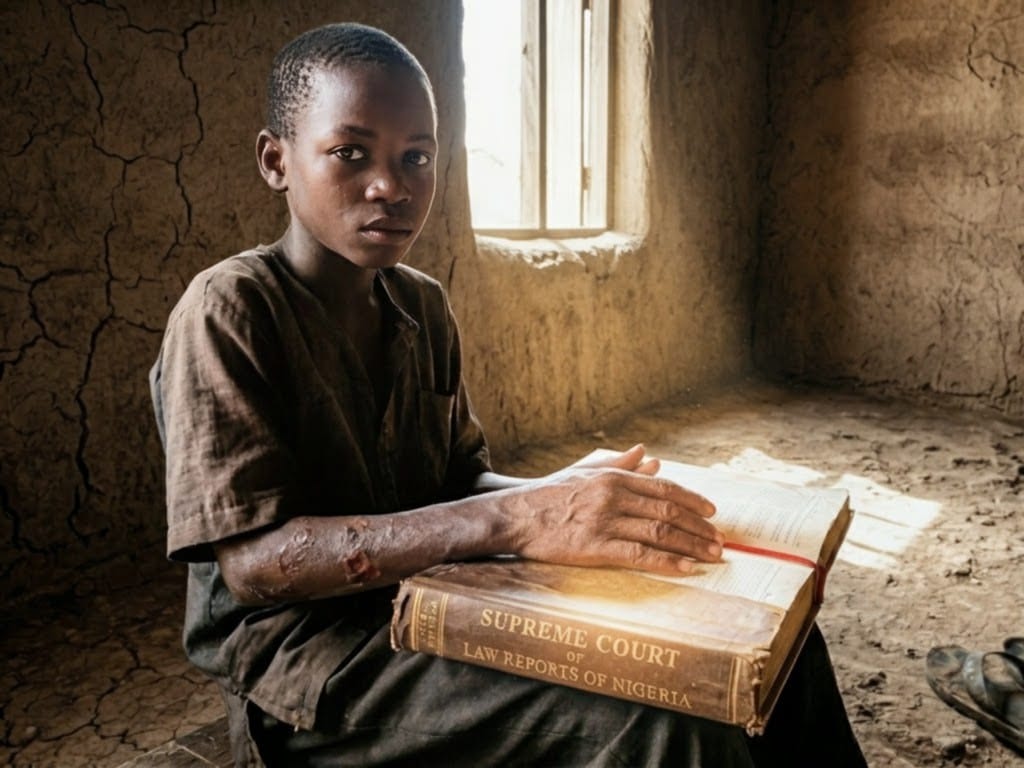
A Boy in Nasarawa. A Law Nobody Used.
When Ovey Friday was 13 years old, his stepmother accused him of witchcraft. She took him to a traditional healer in Nasarawa State. What followed left him without a hand.
The healer who burned and bound him broke Nigerian law. The stepmother who handed him over broke Nigerian law. The community that watched and said nothing allowed Nigerian law to be broken in plain sight.
None of them knew this. And in a country where legal literacy is a privilege of the educated few, that ignorance is not surprising. It is the rule.
This article is about that gap the distance between what Nigerian law actually says and what ordinary people in Northern Nigeria believe it says. Because that gap is not empty. It is filled with burning embers, metal chains, and the bodies of people who did not know they had rights.
What the Law Actually Says
Here is the first fact most Nigerians have never been told: Nigerian law does not recognise witchcraft as real.
Not in the Criminal Code. Not in the Penal Code. Nowhere in the Nigerian legal framework is witchcraft treated as an actual phenomenon that exists in the physical world. The law treats it as superstition which is exactly what it is.
Section 210 of the Criminal Code Act and the corresponding provisions in the Penal Code applicable in Northern Nigeria do not criminalise witchcraft. They criminalise witchcraft accusations. There is a crucial difference.
What the law actually prohibits is this: accusing another person of being a witch, threatening someone with a witchcraft accusation, or claiming to have the power of witchcraft in order to deceive or extort others. Anyone who does any of these things commits a criminal offence punishable by up to two years in prison.
Read that again slowly.
The person who stands in a compound and points at a child and says “this one is a witch” that person has committed a criminal offence under Nigerian law. The mallam or pastor who takes money to “identify” witches in a community that person has committed a criminal offence. The healer who tortures a child to extract a witchcraft “confession” that person has committed multiple criminal offences, including assault, unlawful detention, and in many cases grievous bodily harm.
The law is clear. The enforcement is not.
The Bauchi Contradiction
There is a specific detail from the legal record that Northern Nigerians deserve to know about, because it happened in their own state.
In July 2011, two individuals were brought before the Bauchi State Chief Magistrate’s Court on witchcraft charges. The prosecution argued that the accused had used witchcraft to hold a victim captive. The accused had confessed.
The case exposed something that lawyers and legal scholars have argued about ever since: what exactly does it mean to prosecute a witchcraft case in a legal system that does not recognise witchcraft as real? If witchcraft does not exist, then no one can be guilty of practising it. But the court proceeded.
More recently, the Chief Judge of Bauchi State was reported to have said that witchcraft is “difficult to prove unless a witch confesses” a statement that drew sharp criticism from legal scholars who pointed out that the remark gave undeserved legitimacy to a concept Nigerian law explicitly does not recognise.
This is the contradiction at the heart of the matter. On paper, the law is rational. In practice, even those tasked with upholding the law sometimes speak as though witchcraft is real, which emboldens accusers and leaves victims without protection.
The Child Rights Act: A Law That Exists But Is Not Applied
In 2003, Nigeria passed the Child Rights Act a federal law that prohibits harmful traditional practices against children, including torture and degrading treatment. The Act is explicit: no child can be subjected to physical or psychological harm in the name of tradition, culture, or religion.
On paper, this law protects every child like Ovey Friday.
In practice, as of the time of writing, only 23 out of 36 Nigerian states have domesticated the Child Rights Act. Several Northern states have not adopted it, meaning its protections do not legally apply in those states. In December 2021, three human rights organisations, including the International Human Rights Advocacy and the Centre for Human Rights at the University of Pretoria, took Nigeria to the African Committee of Experts on the Rights and Welfare of the Child specifically alleging that Nigeria had failed to protect children accused of witchcraft from persecution, torture, and inhuman treatment.
Nigeria was sued by international bodies for failing to protect its own children. That case exists. That record is public. And the families in Bauchi, Gombe, and Katsina who hand their children to bokaye (traditional healers) for “treatment” of supposed witchcraft most of them have never heard of any of it.
Why This Information Never Reaches the People Who Need It
The knowledge exists. The laws exist. The court cases exist. UNICEF has documented the abuse. Human Rights Watch has filed reports. International legal bodies have ruled on the matter.
And yet in the communities where children are being chained and burned and accused, none of this reaches the ground.
There are several reasons for this.
Legal aid in Nigeria is almost nonexistent for the poor. A family in a rural area of Bauchi State cannot afford a lawyer. They have no access to legal clinics. The nearest court may require transport they cannot pay for. Even if they knew their rights, exercising them is a different matter entirely.
Beyond access, there is language. Nigerian law is written in English. Enforcement is conducted in English. Judgments are rendered in English. The vast majority of people in Northern Nigeria navigate their daily lives in Hausa and no government body has made it a priority to translate their fundamental rights into a language they can read and understand.
And then there is culture. In many communities, taking a family matter to court is seen as a betrayal. Involving the police is seen as aggression. Even when a victim knows they have been wronged under the law, the social cost of pursuing justice is high enough to silence them.
What You Can Do — Right Now
This is practical information. If you or someone you know faces a witchcraft accusation in Northern Nigeria, here is what Nigerian law actually provides:
First: Accusing someone of witchcraft is a criminal offence. The accuser not the accused is the one who has broken the law. A formal complaint can be filed at any police station under Section 210 of the Penal Code (in Northern states) or the Criminal Code (in Southern states).
Second: If a child has been physically harmed beaten, burned, starved, or tortured under the guise of “spiritual treatment,” this constitutes assault and grievous bodily harm under the Criminal Code. These are serious criminal offences with significant penalties.
Third: Organisations exist specifically to help victims of witchcraft accusations. The Advocacy for Alleged Witches (AFAW) provides legal support and documentation assistance to victims across Nigeria. They can be reached and contacted online.
Fourth: If you are a community leader a district head, a ward councillor, a teacher, a health worker you have the standing to report suspected cases of child abuse resulting from witchcraft accusations to the nearest police station or the National Agency for the Prohibition of Trafficking in Persons (NAPTIP), which handles cases of child exploitation.
None of this requires wealth. None of it requires connections. It requires only the knowledge that these rights exist and the decision to use them.
The Law Is Not Enough. But It Is a Start.
Ovey Friday made it to university. He uses his toes to write. He is, by any measure, remarkable.
But his story should never have required remarkable survival. A 13-year-old should not need extraordinary courage simply to reach adulthood with his body intact. He should have been protected by his family, by his community, and by a legal system that exists precisely for moments like his.
The law says witchcraft is not real. The law says accusing a child of witchcraft is a crime. The law says those who torture in the name of spiritual healing are criminals.
The law says all of this. Loudly. In writing.
The only thing missing is the voice to carry it into the communities where it is needed most.