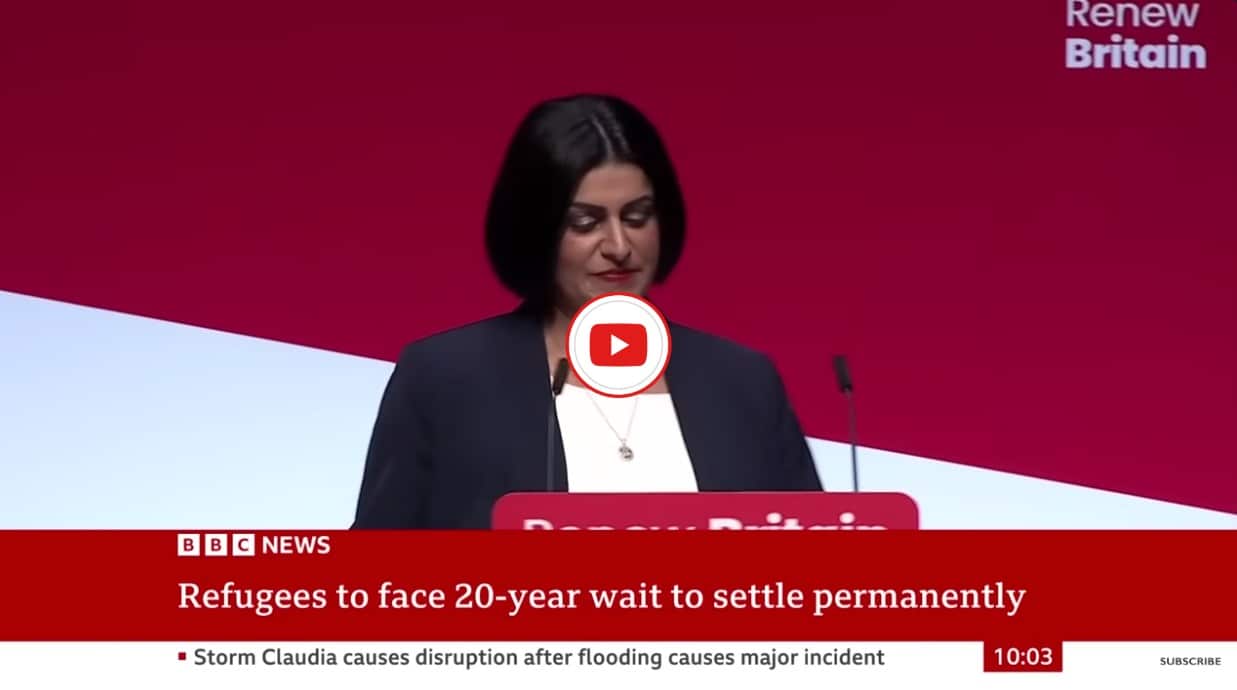
The debate over immigration in the United Kingdom, as in many Western nations, is fraught with deep emotion and political anxiety. When governments announce “sweeping overhauls” of the asylum system, the promise of “restoring control” and providing “fairness” resonates deeply with a public often feeling unheard and burdened by a system that appears slow, chaotic, and costly.
As freethinkers and rational observers, we must first acknowledge the legitimacy of these public worries. Concerns over the rising cost of asylum accommodation, the perceived queue-jumping by irregular arrivals, and the genuine pressure on local services are not merely “far-right talking points”; they are tangible issues that must be taken seriously.
However, a rational critique demands we look beyond the political rhetoric designed to address these fears and examine whether the proposed solutions are, in fact, effective, or merely a sophisticated form of political theatre. The new policies announced by Home Secretary Shabana Mahmood, particularly those targeting irregular arrivals, fall squarely into the latter category, promising deterrence while simultaneously guaranteeing dysfunction.
The New Policy: A Strategy of Engineered Precarity
The core objective of the new UK policy, modelled in part on Denmark’s controversial system, is to make the UK a less attractive destination for asylum seekers who arrive without permission. It achieves this through three highly impactful, and highly punitive, measures:
- The 20-Year Wait for Permanent Settlement: The most severe change is quadrupling the standard wait time for Indefinite Leave to Remain (ILR) from five years to two decades for those granted refugee status who arrived via “illegal” routes.
- Temporary, Revocable Sanctuary: Refugee status is no longer a path to permanent stability. It will be temporary, subject to regular review (every 2.5 years), with the explicit threat of revocation if the situation in the refugee’s home country is deemed safe enough for return.
- Revoking Statutory Support: The legal duty to provide housing and financial assistance to asylum seekers will be revoked, making support discretionary, particularly for those who have the right to work but do not, or those deemed to have broken the law.
These measures are designed to signal strength and act as a psychological deterrent. Yet, when filtered through the lens of social science, psychology, and rational economics, they reveal themselves to be fundamentally self-defeating.
Why Toughness Will Fail: The Rational Case for Integration
The core flaw in these policies is a mismatch between the desired political outcome (deterrence) and the reality of human behavior during mass migration.
1. The Deterrence Myth vs. Push Factors
The foundational assumption of the policy, that making life difficult in the UK will stop people from risking their lives to get here, is contradicted by almost every major study on migration. Asylum seekers are driven overwhelmingly by push factors: conflict, persecution, famine, and existential threat. When facing a choice between near-certain death or severe harm in their home country, and the slim chance of a long, precarious life in the UK, the latter remains the only rational choice. As a result, restrictive policies rarely stop arrivals; they simply reroute them into more dangerous, profitable channels for smugglers.
2. The 20-Year Trap: Stifling Human Capital
Perhaps the most economically and socially damaging policy is the 20-year path to settlement. For the state, this period of precarity is intended as a test or a punishment. For the individual, however, it is a catastrophic block on integration.
A rational person cannot invest in a future that is explicitly temporary. Why would an individual spend years of effort, time, and limited money learning a new trade, obtaining UK-recognised qualifications, or buying property, if they know that every 2.5 years, the government might rescind their right to stay? This policy is not just cruel; it is economically illiterate. It ensures a class of people who are:
- Under-Utilised: They hold back from maximizing their career potential and contributing fully to the tax base.
- Stressed and Isolated: The constant threat of removal destroys mental health, making successful integration nearly impossible.
- A Burden: By preventing full integration, the state perpetuates the very dependence and social cost it claims to be trying to eliminate.
The question asked by many critics is piercingly true: Do we want people living in our country for 20 years who are too insecure to build a real life? The answer, rationally, is no. We want people who are invested, skilled, and rooted, becoming taxpayers and community leaders. This policy guarantees the opposite.
3. Destitution and the Shadow Economy
Removing the statutory duty of support forces asylum seekers, many of whom have no right to work while their claims are processed into destitution. This does not make them self-reliant; it makes them vulnerable. They are forced to rely on charities, or worse, engage in precarious and illegal work, making them victims of exploitation and undermining the very rule of law the policy claims to defend. This is not a saving measure; it is a transfer of cost from central government to public services, local communities, and the police.
The Effective Path: Rational, Science-Based Reform
A truly effective, rational, and humane immigration system would fundamentally change the system, taking public worries seriously by proving that the system is fast, fair, and based on contribution. This requires solutions rooted in established social science and tested international practices.
1. Invest in Fast, Fair Decision-Making
The single biggest cost and source of frustration in the current system is the processing delay. A long queue is expensive for the taxpayer (housing costs) and paralyzing for the asylum seeker.
- Solution: Massively invest in caseworkers and technology to ensure all asylum claims are processed within six months. A quick ‘yes’ means a person can start contributing immediately. A quick ‘no’ means a person can be removed swiftly (where safe and legal to do so). Speed is the ultimate deterrent against queue-jumping and the most potent accelerator of integration.
2. Embrace Contact Theory: The Science of Integration
Psychologist Gordon Allport’s Contact Hypothesis states that prejudice can be reduced when groups engage in cooperative contact under conditions of equal status.
- Solution: Immediately grant asylum seekers the right to work (as done in Canada and many EU countries). This shifts their status from state dependent to contributor. Working with natives on a construction site, in a hospital, or in a business fosters meaningful, equal-status contact, accelerates language learning, and proves their value, all while reducing dependence.
3. Spread the Burden: National Distribution
The public feels frustrated when the visible burden of the system is concentrated in a few areas.
- Solution: Implement a national distribution system, similar to Germany’s model, which allocates new arrivals across all regions of the country based on population size and economic capacity. This prevents local services from being overwhelmed and facilitates integration by matching skills to localized labor shortages (e.g., in social care or agriculture).
4. Tackle Root Causes
For the sake of long-term sustainability and human life, the international community must focus efforts upstream.
- Solution: Dedicate a significant portion of the migration budget to foreign policy, conflict resolution, and development aid in the countries that generate the most displacement. This is not charity; it is a long-term investment in regional stability, which is the only truly effective measure to reduce irregular migration in a sustainable way.
Conclusion
The UK’s new immigration policy is a powerful piece of political messaging that reassures voters that “tough measures” are being taken. But as freethinkers, we must insist on rational analysis.
The current system has indeed made victims of too many immigrants, trapping them in limbo, and it has rightly caused public frustration. However, the proposed “solution” merely swaps a chaotic system for a deliberately cruel one, sacrificing the long-term benefits of successful integration for the short-term satisfaction of political performance.
True control is not about increasing misery; it is about increasing efficiency and promoting contribution. The only way to secure public consent for an asylum system is to make it fast, fair, and structured to quickly transform a refugee into a productive, tax-paying, and deeply integrated member of society. Any policy that prolongs precarity is not a solution. It is a societal and economic failure.