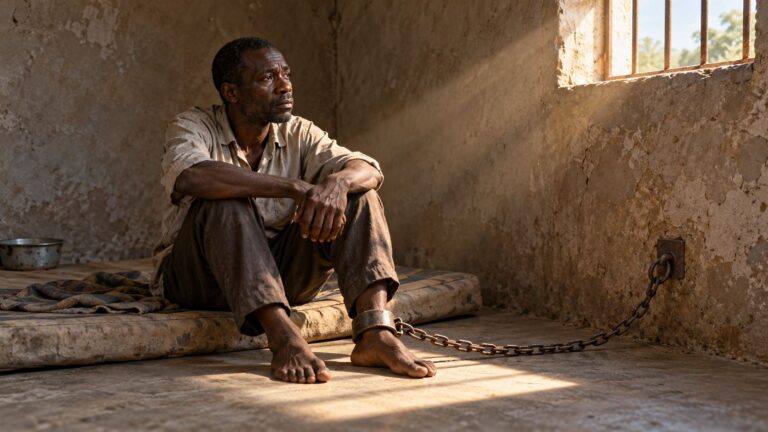
Mubarak Bala, a name that resonates with courage, conviction, and controversy, has walked free after serving more than four years in prison for a crime that many argue should not exist in a free society. Convicted of blasphemy in northern Nigeria’s Kano state, Bala’s release is a moment of reflection—a bittersweet milestone for Nigeria’s small but resilient community of atheists and humanists.
Bala, 40, emerged from the prison gates in Abuja, visibly weary but cheerful, dressed in a simple white T-shirt, khaki shorts, and flip-flops. His first words as a free man—“Everything is new to me”—carry the weight of a man reentering a world that has changed, even as the struggles for freedom of thought and expression remain painfully familiar.
A Guilty Plea That Sparked Debate
Arrested in 2020 after a group of lawyers filed a complaint about a controversial Facebook post, Bala spent two years in detention before being convicted in 2022. His surprise guilty plea to 18 charges baffled even his legal team, sparking intense debate among freethinkers. Why would an outspoken critic of religious dogma concede to charges that many consider a direct affront to freedom of expression?
Bala’s explanation is both poignant and pragmatic. “I believe what I did saved not only my life but people in Kano,” he said. “Especially those that were attached to my case, because they are also a target.” For Bala, the plea was a sacrifice, a calculated move to relieve the immense pressure on his family, friends, and lawyers.
But his decision has left lingering questions. Did Bala’s guilty plea inadvertently validate laws that criminalize blasphemy? Or was it a necessary act of self-preservation in a society where religious dissent is often met with violence and ostracism?
A Nation’s Struggle with Secularism
Nigeria’s dual legal system—a blend of Islamic (Sharia) law and secular law—exposes the deep fissures in a nation grappling with religious pluralism. In 12 northern states, including Kano, blasphemy is a crime under Sharia law. It is also punishable under Nigeria’s criminal law, further complicating the fight for secularism and freedom of thought.
Bala’s case has drawn widespread condemnation from international rights groups, sparking a global debate about the limits of free speech in deeply religious societies. Leo Igwe, founder of the Humanist Association of Nigeria, encapsulated the mixed emotions surrounding Bala’s release: “Thanks, that he’s out, thanks that he’s a free man. But no thanks, because there is a dent on him as if he committed a crime. For us at the Humanist Association, he committed no crime.”
Freedom with an Asterisk
As Bala begins his life outside prison walls, the shadow of his incarceration looms large. Living in a safe house to avoid threats, he remains acutely aware of the risks he faces. “Freedom is here, but also there is an underlying threat I now have to face,” he said. For Bala, freedom is bittersweet, marred by the ever-present danger of reprisal in a deeply religious society.
His activism, which began when he renounced Islam in 2014, has always been a precarious endeavor. “I always knew the worst would happen,” he admitted. “When I made the decision to come out, I knew I could be killed. I knew the dangers, and I still decided to do it.”
What Does This Mean for Freethinkers?
Bala’s release is both a victory and a sobering reminder of the challenges faced by freethinkers in Nigeria and beyond. It raises urgent questions for the global community: How can freethinkers advocate for secularism in societies where religion wields immense power? What role should international organizations play in defending individuals like Bala? And perhaps most critically, how do we balance the fight for free speech with the realities of personal safety in hostile environments?
For Bala, the path forward includes reconnecting with his family, particularly his young son, who was just six weeks old when Bala was imprisoned. But the road ahead is fraught with challenges, not just for him but for all who dare to question religious orthodoxy in deeply conservative societies.
Mubarak Bala’s story is far from over. It is a chapter in the ongoing struggle for freedom of thought, a struggle that calls on all of us to confront uncomfortable truths about the limits of liberty in an increasingly polarized world.
A Call to Action
As freethinkers and secularists, we must ask ourselves: What can we do to ensure that no one else endures what Bala has suffered? How can we amplify the voices of those who risk everything to speak their truth? Mubarak Bala’s courage reminds us that the fight for freedom of thought is far from won—and that our collective efforts are needed now more than ever.