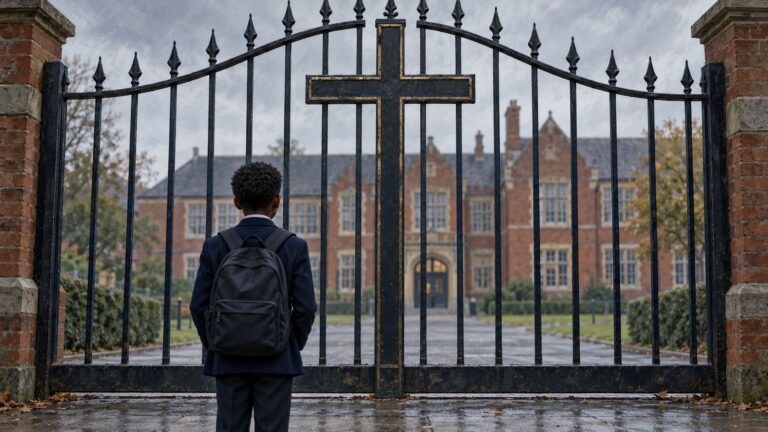
The battle over religion’s place in public education is heating up once again, this time in the heartland of Ohio, where faith leaders and secular activists are clashing over the implementation of released-time religious instruction programs. At the center of the controversy is LifeWise Academy, a Christian Bible education initiative that allows public school students to leave school during the day for religious classes held off-campus. While supporters champion the program as a much-needed return to moral and character education, critics decry it as an erosion of the separation between church and state.
This debate has spilled beyond Ohio’s borders, with faith leaders taking their campaign to Wisconsin, urging school boards to adopt similar programs. The Freedom From Religion Foundation (FFRF), an atheist legal organization based in Wisconsin, has become a focal point of criticism from Ohio clergy. Pastor John Bouquet of Ashland County dismissed the FFRF as “angry atheists” meddling in Ohio’s affairs, claiming their opposition is based on misleading information about the legality of released-time programs.
“In this country, angry atheists are free to be wrong,” Pastor Bouquet quipped. “When it comes to Acts of GOD, they will always be on the losing side.”
Such statements are not unusual in the ongoing culture war over the role of religion in public life. However, they do little to address the larger questions raised by programs like LifeWise Academy: Is it truly possible to offer released-time religious instruction without indirectly entangling public schools in matters of faith? And is the growing embrace of such programs a reflection of genuine moral concern or a calculated effort to reclaim public schools for Christian evangelism?
Legal but Contentious
Proponents of released-time religious instruction point to the 1952 U.S. Supreme Court decision Zorach v. Clauson, which upheld the constitutionality of such programs provided they are off-campus, privately funded, and voluntary. Yet critics argue that the lines between public and private are often blurred in practice. For instance, LifeWise Academy touts partnerships with hundreds of school districts, raising concerns about the implicit endorsement of religious instruction by public institutions.
Ohio’s recent legislative developments have only fueled these concerns. At the end of the 2023-24 session, Governor Mike DeWine signed a law requiring local school boards to adopt policies on released-time religious instruction. While the law technically adheres to the constitutional guidelines established by Zorach, its passage underscores a broader shift: the normalization of religious instruction as a feature of public education.
“We have lost several generations to secular humanism,” said Pastor Eric Steward of Richland County, a co-signer of the clergy letter promoting LifeWise Academy. “There is no reason why any Christian faith leader should oppose this program.”
This framing—“secular humanism” versus Christian morality—reveals the ideological underpinnings of the movement. It is not simply about offering students the option to explore religion but about actively countering what faith leaders perceive as a moral vacuum left by the absence of religious teachings in public schools.
A Freethinker’s Perspective
For freethinkers and secularists, the rise of programs like LifeWise Academy is both a challenge and an opportunity—a challenge to the principles of secular governance and an opportunity to interrogate the deeper societal currents driving this movement. The program’s supporters argue that it meets a pressing need for moral and character education, citing polls that show broad public support for such initiatives. But is moral education synonymous with religious education? And whose morals are being taught?
The FFRF has taken a firm stance against LifeWise Academy, warning that these programs risk entangling public schools in unconstitutional religious promotion. Yet the organization’s critics, like Pastor Bouquet, dismiss these concerns as unfounded and politically motivated.
As secularists, we must ask: Are these programs the thin end of a wedge that could lead to greater religious influence in public schools? Or are they, as their proponents claim, a constitutionally sound means of addressing a genuine societal need? The answer may depend less on legal technicalities and more on the broader cultural and political context in which these debates are unfolding.
The Bigger Picture
LifeWise Academy’s rapid expansion—from two pilot programs in 2019 to nearly 50,000 students across 29 states—is emblematic of a larger trend. Faith-based initiatives are finding new footholds in public life, often under the banner of community service or educational enrichment. For many Americans, this is a welcome development, a way to counteract what they see as the moral decline of a secularized society. For others, it is a troubling erosion of the wall separating church and state.
The independent study cited by LifeWise supporters, which claims improvements in student attendance and behavior, adds another layer of complexity. If these programs yield tangible benefits, can they be dismissed outright? Or do the ends fail to justify the means if they come at the expense of secular principles?
Sparking Debate
At its core, the debate over LifeWise Academy is about more than one program or even one state. It is about the role of religion in public life, the meaning of secularism, and the future of American education. For freethinkers, this is not a time for complacency. It is a time to engage, to question, and to advocate for solutions that respect the diversity of beliefs in our society while upholding the constitutional principles that protect us all.
The clergy’s letter to Wisconsin school boards ends with an appeal to partnership: “We believe this innovative Bible education program offered to public schools is having a profound impact on the lives of students.” But partnership cannot come at the cost of pluralism. As freethinkers, we must ensure that public education remains a space for all students, regardless of faith or lack thereof.
What do you think? Are released-time programs a constitutional exercise of religious freedom or a step too far into the public sphere? Share your thoughts—this is a conversation we all need to have.