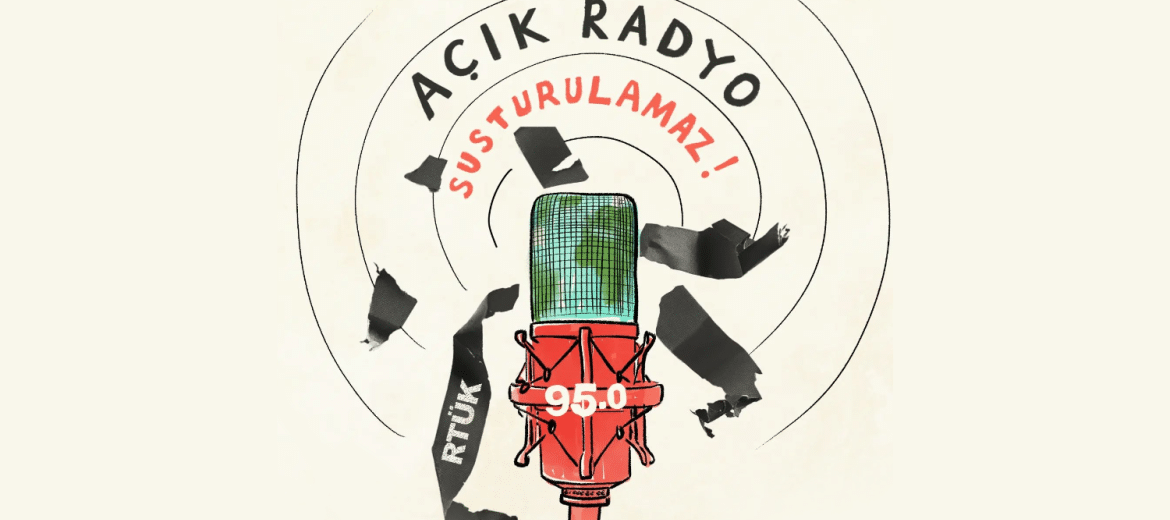
The terrestrial broadcast license of Açık Radyo*, which has been broadcasting in Turkey for 30 years under the motto ‘Open to all the sounds, colors, and vibrations of the universe!’, has been revoked. The silencing of this non-profit, independent radio station—free from all interest groups—is far from a trivial matter; it is a political one. Now, we turn to an academic who has made invaluable contributions to the field of communication in Turkey, sharing their insightful and inspiring article with you.
The Closure of Açık Radyo and My Lifelong Passion for Radio
As a child, the world of sound always captivated me. My love for radio began in the most unlikely ways—small objects, like a keychain or a toy, would become a stand-in for a radio in my imaginative games. I’d hold them close, pretend they transmitted waves of sound from distant, unknown places. The radio wasn’t just a device for me—it was a window to the world, a storyteller, a companion. Its static-filled whispers and the ever-changing voices that flowed through the airwaves made me feel connected to something larger, something invisible yet deeply present.
Growing up, this fascination with sound and voices evolved into something much deeper, shaping the very foundation of my academic and professional life. My entire career became intertwined with the medium of radio. I delved into its history, its power to inform, to entertain, to inspire, and most importantly, to connect people. Radio wasn’t just technology—it was art, culture, politics, and a lifeline to those whose voices often went unheard. In many ways, I owe much of who I am to the transformative potential of radio.
Açık Radyo has always represented this very spirit of radio to me. Founded in November 1995, it was a space where voices from the margins found a home. Born at a time when Turkey was grappling with significant political and social changes, Açık Radyo emerged as a beacon of free expression. The station’s slogan, “To all the sounds, colors, and vibrations of the universe, Açık Radyo”, rang true to its mission. Whether it was environmental concerns, minority rights, or independent music, Açık Radyo was unafraid to take on the issues that other stations shied away from.
In its almost thirty years of broadcasting, the station gave voice to countless movements and ideas. It wasn’t about mainstream ratings or commercial success—it was about providing a platform for dialogue, a rarity in an increasingly controlled media landscape. I admired how Açık Radyo championed alternative narratives and embraced a wide spectrum of opinions, always maintaining a commitment to intellectual and cultural diversity.
The news of Açık Radyo’s closure on October 16th struck me with a sense of personal loss, as if a dear friend had fallen silent forever. It felt like the end of an era, not only for radio but for what radio represents in a democratic society. Radio has always been, at its core, a democratizing medium—a space where people from different walks of life can share ideas, challenge authority, and create community. With Açık Radyo’s closure, an essential pillar of Turkey’s independent media collapsed, casting a shadow over the future of free expression in the country.
For me, radio is more than a professional interest. It’s part of my identity. To see a platform like Açık Radyo silenced is heartbreaking. It reminds me of the fragility of the freedoms we often take for granted—freedom of the press, freedom of speech, and, by extension, the right to be informed and engaged citizens.
It is also a stark reminder that these freedoms must be defended vigorously, especially in times when democratic institutions are under threat. The closure of Açık Radyo is not just about a single station—it’s about the narrowing of the public sphere, the silencing of dissent, and the increasing grip of authoritarianism on media outlets that dare to challenge the dominant narrative.
I think back to my childhood, to the joy and wonder I felt listening to the radio, and how that joy transformed into a lifelong passion for exploring the power of sound and communication. The child who once called a keychain “radio” could never have imagined a world where those very radios could be silenced by forces beyond his control. Yet here we are, in a moment of deep reflection and sadness.
It’s not just nostalgia that drives my sorrow, though the memories of growing up with radio certainly play a part. It’s the understanding that Açık Radyo was more than just a station. It was a symbol of what radio could be—a platform for free thought, creative expression, and public discourse. Its silence marks a step backward for Turkish media, one that we must not accept passively.
As I look to the future, I can’t help but think about the next generation of radio enthusiasts, the children who might grow up never knowing the magic of a truly independent radio station. I hope that, in some way, my work and the work of others in this field can help preserve the legacy of Açık Radyo and what it stood for. We must continue to fight for spaces where voices can be heard, where ideas can be debated, and where freedom can thrive.
Perhaps one day, the radio will return, carrying with it the voices of a new generation, eager to share their stories, their struggles, and their dreams. And when that day comes, I’ll be listening, just as I always have, with a heart full of hope and a deep appreciation for the power of sound.
*can be translated as “Open Radio” if necessary.