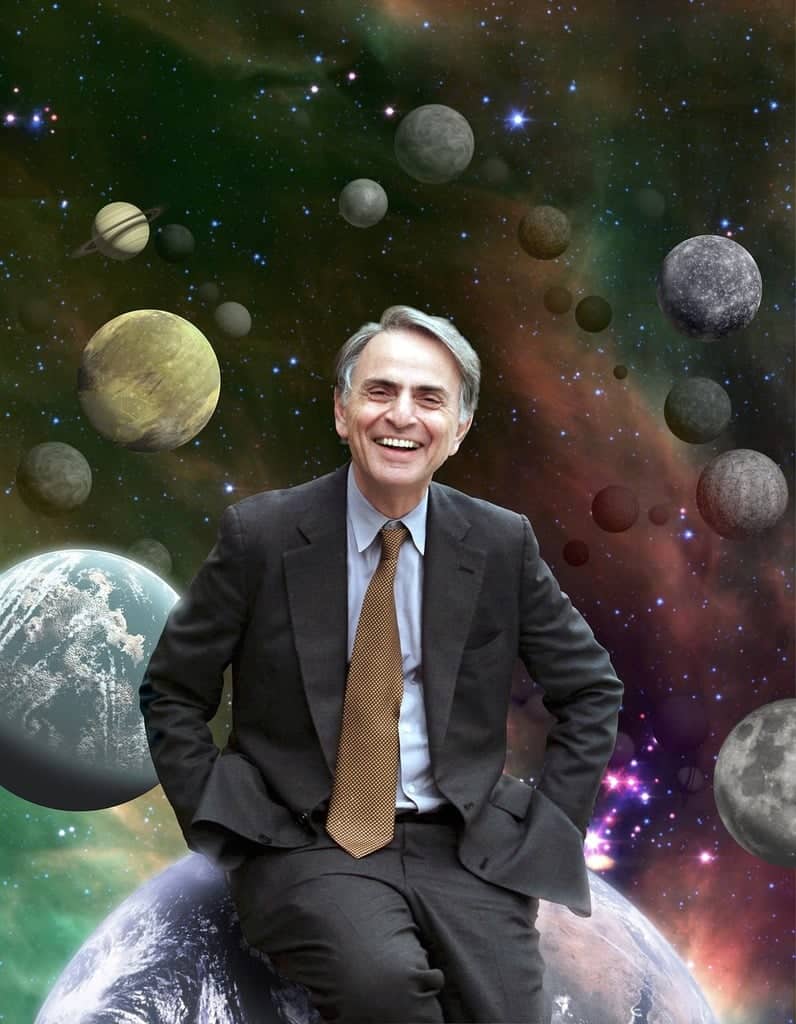
Carl Sagan, a pioneering American astronomer, cosmologist, and passionate science communicator, brought the mysteries of the universe down to Earth, making them accessible and inspiring to millions. His work, particularly the groundbreaking television series Cosmos and his bestseller The Demon-Haunted World, emphasized the beauty and power of science while promoting skepticism, reason, and critical thinking. Sagan’s ability to convey complex scientific ideas in a poetic and engaging way made him one of the 20th century’s most beloved figures in both science and popular culture. More than a scientist, Sagan was a freethinker who championed human curiosity and a rational worldview, leaving behind a legacy of wonder and reason.
This episode is also available as podcast via your favorite podcast app
A Life Dedicated to Science and Curiosity
Born in Brooklyn, New York, in 1934, Carl Sagan developed a fascination with the stars at an early age. His parents encouraged his curiosity, and young Sagan often visited the public library, voraciously reading about the universe. This early passion for astronomy would define his career, but Sagan’s interests stretched far beyond the confines of any single scientific discipline.
Sagan earned degrees in physics and astronomy, ultimately receiving his Ph.D. from the University of Chicago in 1960. His early scientific work included groundbreaking research on planetary atmospheres, including Venus’ runaway greenhouse effect and Mars’ seasonal changes. He played a key role in the early days of space exploration, working as a consultant for NASA on missions such as the Mariner, Viking, Voyager, and Galileo spacecraft. His contributions included helping design the famous “Golden Record,” a message intended for potential extraterrestrial life aboard the Voyager spacecraft.
Despite his technical achievements, Sagan was best known for his ability to communicate the wonders of science to the public. His 1980 TV series Cosmos: A Personal Voyage, which reached more than 500 million viewers worldwide, remains one of the most popular and influential science documentaries ever produced. In Cosmos, Sagan invited viewers to contemplate their place in the universe, blending cutting-edge astronomy with human history and philosophy in a deeply compelling narrative.
Dogmas Disputed: Pseudoscience, Religion, and Anthropocentrism
Carl Sagan was a vocal critic of pseudoscience and unscientific thinking. Throughout his career, he battled against astrology, UFO myths, and other forms of pseudoscientific belief that, in his view, undermined rational thinking and distracted from the pursuit of real knowledge. In The Demon-Haunted World: Science as a Candle in the Dark (1995), Sagan laid out a strong case for scientific skepticism, calling for a society that values evidence-based thinking and a scientific approach to understanding the world. He argued that, while science offers no easy answers, it provides the best tools for uncovering truths about the universe.
Sagan was also critical of traditional religious beliefs, particularly those that conflicted with scientific discoveries. He rejected the idea of a personal God, instead expressing a kind of agnosticism. He was open to the possibility of some form of spiritual experience but grounded in the sense of wonder and awe one feels when contemplating the vastness and beauty of the cosmos, rather than traditional religious doctrines.
Despite his skepticism toward organized religion, Sagan was not hostile to religious sentiment. He believed that the sense of mystery and the search for meaning in the universe were deeply human impulses, and he often spoke in terms that evoked a kind of scientific spirituality. He encouraged people to seek wonder and meaning through science rather than superstition, urging humanity to embrace its insignificance in the cosmic scale as a humbling and unifying experience.
A consistent theme in Sagan’s work was his challenge to anthropocentrism—the belief that humans occupy a privileged or central place in the universe. Sagan emphasized that the Earth is but a “pale blue dot” in the vast expanse of space, and he urged humanity to adopt a more modest and ecological perspective. His iconic words, reflecting on a photograph of Earth taken from the Voyager spacecraft, captured his view of humanity’s fragile place in the universe: “Look again at that dot. That’s here. That’s home. That’s us.”
Core Beliefs
At the core of Carl Sagan’s worldview was a deep commitment to scientific skepticism—the idea that extraordinary claims require extraordinary evidence, and that knowledge should be based on observation, experimentation, and reason rather than faith or intuition. Sagan believed that the scientific method was not only a tool for understanding the physical world but also a powerful way of thinking that could improve human life by promoting clarity, critical thinking, and skepticism toward unfounded beliefs.
Sagan’s sense of cosmic humility also defined his outlook on humanity’s place in the universe. He was a firm believer in the idea that science, far from diminishing our sense of wonder, could expand it by revealing the true majesty and scale of the cosmos. For Sagan, the universe was not just a backdrop for human existence but an invitation to contemplate our place within it. His words captured this feeling: “We are a way for the cosmos to know itself.”
His advocacy for space exploration was rooted in both practical and philosophical concerns. On a practical level, Sagan believed that exploring other planets and searching for extraterrestrial life could lead to scientific breakthroughs and provide humanity with a sense of purpose. Philosophically, he saw space exploration as a way of broadening humanity’s horizons, fostering cooperation among nations, and inspiring future generations to think beyond the narrow confines of Earthly concerns.
Opposition Faced
Carl Sagan’s outspokenness in defense of science and reason often placed him in opposition to those promoting pseudoscience, religious fundamentalism, and unscientific thinking. His skepticism of UFO claims, for example, made him a target for believers in extraterrestrial visits, and his critiques of astrology and the paranormal sparked backlash from New Age circles. Some religious groups also criticized Sagan for his rejection of traditional religious views and his embrace of a secular, scientific spirituality.
Despite his widespread popularity, Sagan was not immune to professional criticism. His involvement in popular science communication—particularly through Cosmos—sometimes led fellow scientists to dismiss him as more of a media figure than a serious researcher. However, Sagan consistently defended the importance of making science accessible to the public, arguing that an informed society was essential to both democracy and human progress.
Legacy and Modern Relevance
Carl Sagan’s legacy is one of inspiration, education, and intellectual rigor. Through his books, television shows, and public appearances, Sagan transformed the way millions of people think about science and the universe. His ability to connect complex scientific concepts with everyday experience made him a beloved figure and established him as one of the greatest science communicators in history.
Sagan’s advocacy for skepticism and critical thinking continues to resonate in today’s world, where misinformation and pseudoscience remain widespread. His insistence on the importance of evidence-based thinking is particularly relevant in an age of internet-driven conspiracy theories and fake news. Sagan’s work serves as a reminder of the importance of maintaining a skeptical, open-minded approach to new ideas while demanding rigorous evidence for extraordinary claims.
His environmental advocacy and warnings about humanity’s impact on the planet also feel prescient in the context of today’s climate crisis. Sagan was an early proponent of the idea that Earth’s fragile ecosystem requires our stewardship, and he believed that space exploration could inspire humanity to take better care of its only home.
Critical Analysis
Carl Sagan’s blend of science, philosophy, and wonder made him a unique figure, but it also left him open to criticism from various quarters. Some scientists viewed his broad-reaching communication efforts as diluting the rigor of his work, while others felt that his musings on extraterrestrial life and his openness to speculative ideas (such as the possibility of advanced alien civilizations) were not grounded in sufficient evidence. However, Sagan always insisted that scientific exploration should be accompanied by imagination and curiosity, which could push the boundaries of human understanding.
Some critics also argue that Sagan’s spiritual view of the cosmos, though grounded in science, sometimes bordered on the sentimental, especially when compared to the more hard-nosed skepticism of figures like Richard Dawkins. Yet it was precisely Sagan’s ability to connect science with human emotion and experience that made his work so compelling to a broad audience.
Further Reading and Resources:
- Cosmos (1980)
- The Demon-Haunted World: Science as a Candle in the Dark (1995)
- Pale Blue Dot: A Vision of the Human Future in Space (1994)
- The Carl Sagan Institute at Cornell University
Thought-Provoking Summary:
Carl Sagan dedicated his life to revealing the wonders of the universe while championing critical thinking and skepticism. His work invites us to embrace the beauty of science, not as a cold, mechanistic process, but as a pathway to deeper understanding and connection with the cosmos. In a world often clouded by superstition and misinformation, Sagan’s legacy shines as a beacon of reason, reminding us to approach the unknown with both curiosity and humility. As Sagan himself put it: “Somewhere, something incredible is waiting to be known.”