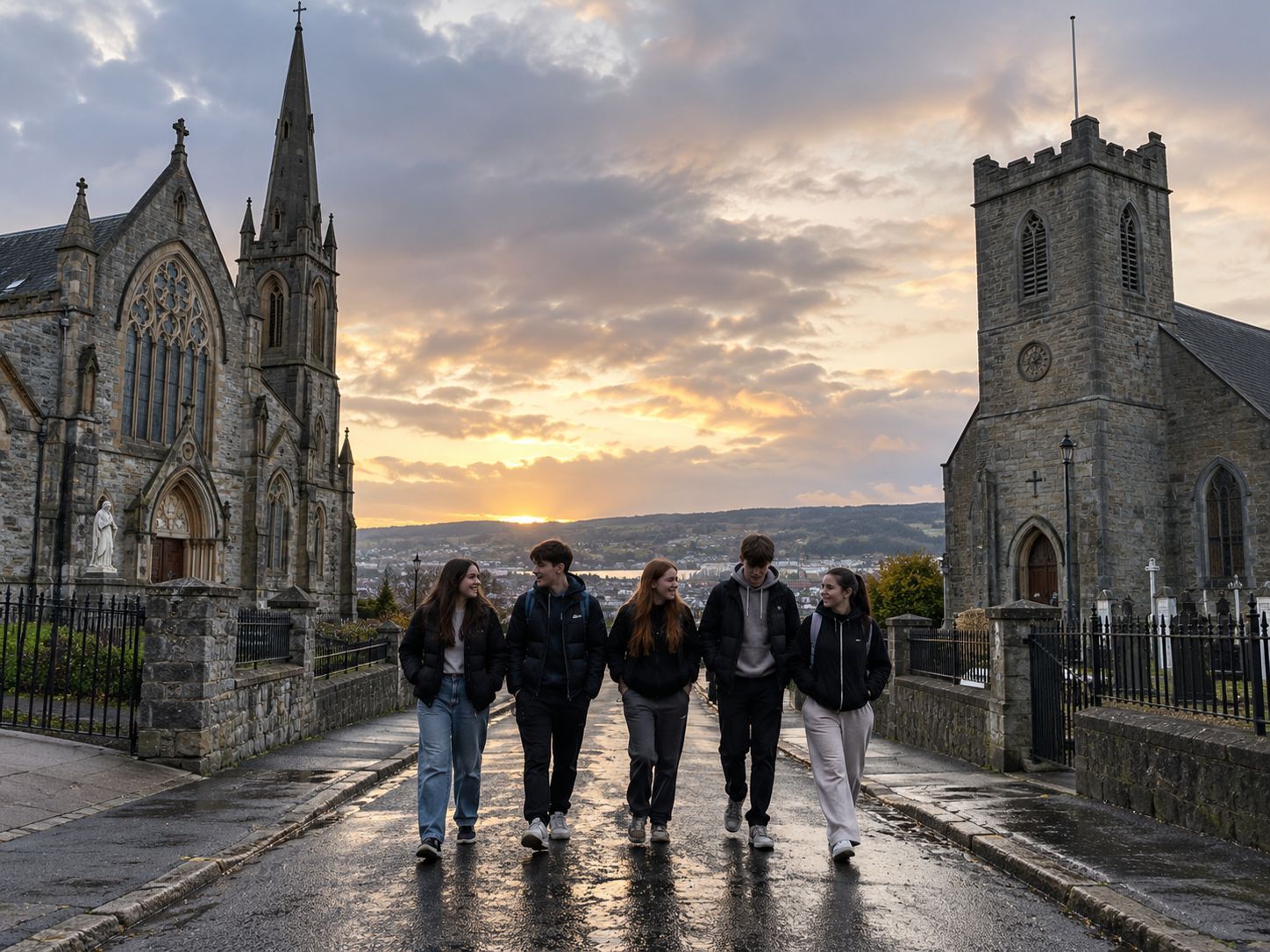
Northern Ireland has spent generations divided along religious lines. For a growing share of its youngest generation, however, the answer to the question of religion is much simpler: none.
A new survey of 16-year-olds in Northern Ireland found that 39% said they belonged to no religion. That makes the non-religious the largest single religious-identity category among those surveyed.
Catholics accounted for 35% of respondents. Protestant and other Christian denominations accounted for 24%, while 2% identified with other religions. Christians collectively therefore remain a majority, but neither of Northern Ireland’s traditional Christian communities individually matches the non-religious group.
For a society in which Catholic and Protestant identities have influenced politics, education and community life for generations, the figures offer another indication of substantial generational change.
No religion is now the largest single group
The findings come from the 2026 Young Life and Times Survey. The annual project has collected the opinions and experiences of 16-year-olds in Northern Ireland since 2003.
This year’s survey was conducted between March 30 and May 1. A total of 1,965 16-year-olds participated.
The religious breakdown is striking:
- 39% — no religion
- 35% — Catholic
- 24% — Protestant or other Christian
- 2% — other religions
The result should not be interpreted as showing that most Northern Irish teenagers are non-religious. They are not, according to this survey. Christian respondents still constitute a majority when Catholic and Protestant or other Christian respondents are combined.
What has changed is the size of the individual categories. No religion is larger than either Catholicism or Protestant/other Christianity considered separately.
Northern Ireland is becoming less religious
The findings do not appear in isolation.
Northern Ireland’s 2021 census found that 17.4% of the overall population reported having no religion. In 2011, the figure had been only 10.1%.
That represents a substantial increase in just one decade.
The census asks another question that makes Northern Ireland particularly interesting. It records not only a person’s current religion but also the religion in which that person was brought up.
When religious upbringing was included, only 9.3% of the population in 2021 fell into the category of neither belonging to nor having been brought up in a religion. That figure had also increased substantially from 5.6% in 2011.
In other words, religious heritage remains considerably more widespread than active religious identification.
The latest survey of 16-year-olds suggests that this distinction may become increasingly important.
The generation gap is substantial
Age already makes a major difference to religious identification in Northern Ireland.
The 2025 Northern Ireland Life and Times Survey, which examines adults, found that 27% of respondents overall reported no religion. Among people aged 18 to 24, however, the figure was 33%. Among those aged 65 and over, it was only 17%.
The new survey cannot simply be placed alongside those figures as though all of the surveys were identical. They involve different samples and should be interpreted separately.
Nevertheless, they point in the same broad direction. Younger people are considerably more likely to report no religious affiliation than older people.
The 2026 figure among 16-year-olds is now 39%.
Religion in Northern Ireland has never been only about belief
There is an important complication.
Calling yourself Catholic or Protestant in Northern Ireland has historically meant considerably more than stating what you believe about God.
Religious background became deeply connected with community identity and Northern Ireland’s political divisions. Catholic and Protestant labels can therefore describe family background and cultural identity as well as personal religious conviction.
That makes the growth of the “no religion” category particularly interesting.
A teenager who selects no religion is not necessarily an atheist. The category can include atheists, agnostics, people who are indifferent to religion and people who retain spiritual beliefs without identifying with an organized religion.
The survey therefore does not show that 39% of Northern Ireland’s 16-year-olds are atheists.
It shows something narrower, but still significant: 39% say they do not belong to a religion.
A society still shaped by religious institutions
The demographic shift also raises questions about institutions built when religious affiliation was far more universal.
Northern Ireland’s education system remains heavily influenced by historical religious divisions. Most pupils attend schools associated predominantly with either the Catholic maintained sector or the controlled sector, although integrated education has expanded.
Northern Ireland Humanists argues that the new figures demonstrate that public policy has failed to keep pace with demographic change. The organization wants greater separation between religion and state, reform of religious education and expansion of integrated schooling.
That is the organization’s interpretation of the findings rather than a conclusion established by the survey itself.
The underlying demographic change, however, is measurable.
Northern Ireland recorded 10.1% of its population as having no religion in 2011. By 2021, that had risen to 17.4%.
Now, among the 1,965 16-year-olds surveyed in 2026, the figure is 39%.
From Catholic versus Protestant to something else
For much of modern Northern Irish history, religious identity was commonly framed as a division between two large communities: Catholic and Protestant.
That framework has not disappeared. Religious and community identities remain important, and the new survey certainly does not demonstrate the end of sectarian divisions.
But the demographic landscape is becoming more complicated.
Among these 16-year-olds, the largest single answer is neither Catholic nor Protestant.
It is no religion.
For Northern Ireland, that may be one of the clearest signs yet of how differently a new generation is beginning to define itself.