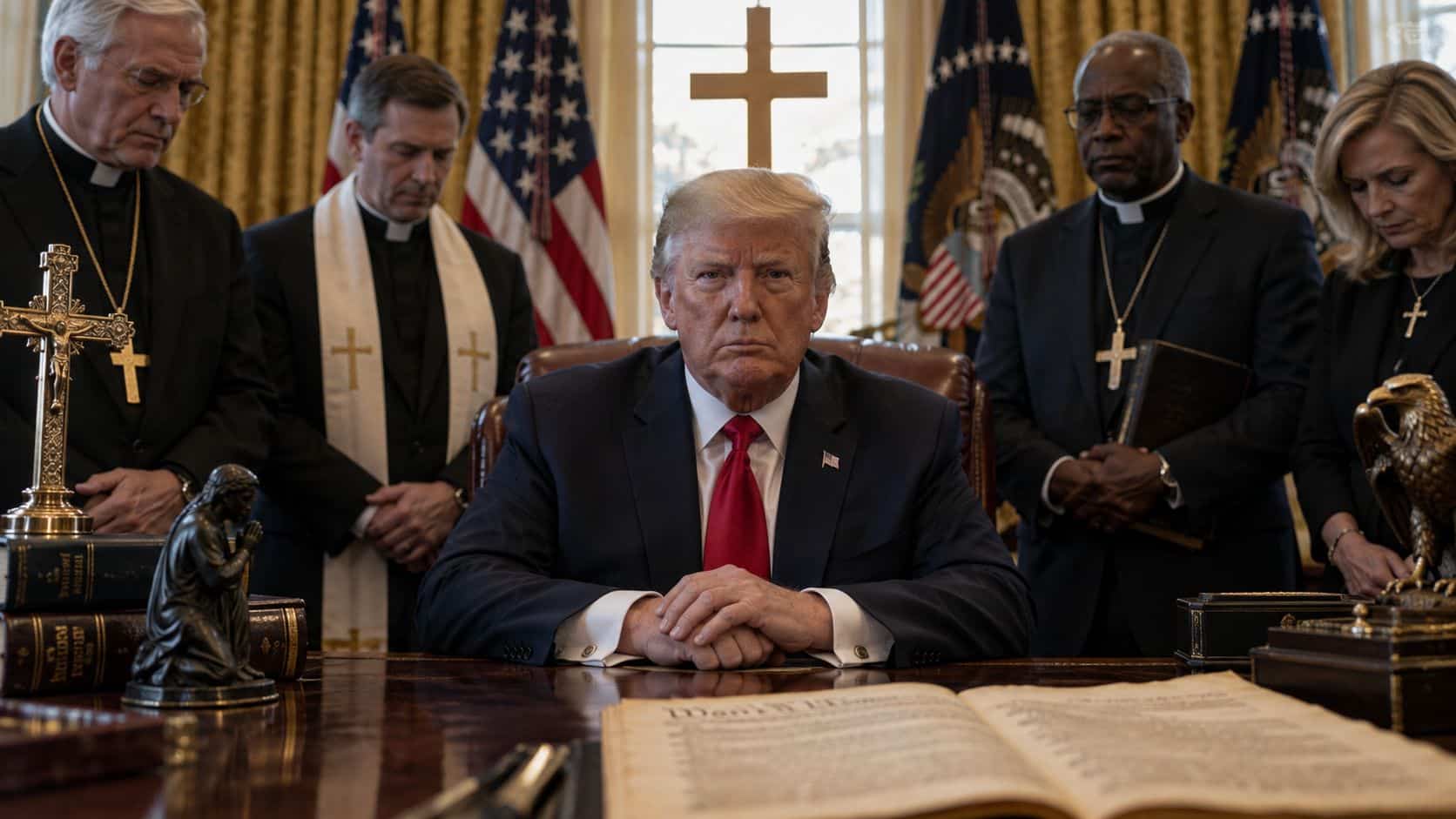
The White House has published an extraordinary document celebrating what it calls President Donald Trump’s “Top 250 Victories For People of Faith.” Released on September 17, the list presents religion not merely as one protected part of American civil society, but as a major organizing theme of the administration’s domestic and foreign policy.
The document covers everything from religious exemptions and school policy to abortion, transgender issues, Israel, federal funding, prayer, education and the role of faith inside government.
Many of the measures concern genuine questions of religious liberty. Others, however, go considerably further. They reflect the administration’s broader interpretation of what it means for government to support religion.
For secular Americans, that raises an obvious question: where does protection of religious freedom end, and preferential treatment of religion begin?
The White House is celebrating religion as policy
The administration divides its 250 claimed achievements into 25 categories. These include protecting religious liberty, defending houses of worship, securing conscience rights, expanding school choice, supporting Israel, partnering with faith communities and “affirming faith in America.”
Among its first accomplishments, the White House highlights the establishment of a White House Faith Office located in the West Wing, faith liaisons across federal departments and agencies, and a Religious Liberty Commission. It also celebrates the creation of a Task Force to Eradicate Anti-Christian Bias.
The administration says these institutions are designed to protect believers against discrimination.
That goal is not inherently inconsistent with secular government. Religious discrimination is real, and believers are protected by the same constitutional freedoms as everyone else.
Yet religious liberty is not the same thing as government promotion of religion.
The First Amendment contains two religion clauses. Government may not prohibit the free exercise of religion, but it also may not establish religion. American constitutional law has therefore historically required government to navigate between protecting religious exercise and avoiding improper governmental preference for religion.
Christianity receives particular attention
Although the White House document frequently speaks about “people of faith” broadly, Christianity occupies a prominent position.
The administration highlights its Task Force to Eradicate Anti-Christian Bias and says it investigated what the government describes as systematic discrimination against Christians during the Biden administration. It also points to federal actions concerning Christian employers, Catholic institutions, religious foster parents and pro-life activists.
The White House additionally celebrates steps allowing faith-based organizations greater participation in federal programs and grant systems.
Some of these policies may be understood as attempts to ensure that religious organizations are not excluded simply because they are religious. Others involve much more difficult conflicts between religious exemptions and the rights of employees, patients, students or other citizens.
For example, the document praises policies protecting healthcare workers who object to abortion, sterilization or assisted suicide on religious or conscience grounds. It also highlights actions involving Christian employers and rules concerning pronouns, restrooms and dress codes.
Those cases illustrate the central difficulty. One person’s religious liberty can sometimes collide with another person’s access to services, workplace protections or equal treatment.
Religion enters the classroom
Education appears repeatedly throughout the document.
The White House celebrates federal guidance emphasizing the right of students and school employees to engage in religious expression. It also praises school-choice policies that make it easier for parents to choose religious schools.
Again, the constitutional distinction matters.
Students do not lose their religious freedom when they enter a public school. A student may pray voluntarily. A government institution directing, organizing or coercing religious participation raises a different constitutional question.
The White House also describes secular positions on gender and sexuality in explicitly ideological terms. Its document refers to what it calls “radical secular ideologies” and celebrates policies restricting gender-related material in education.
That language makes the document more than a simple catalog of protections for private religious belief. It places several major cultural and political disputes inside a framework of faith versus secular ideology.
Abortion and LGBT issues become “faith victories”
A significant portion of the list concerns abortion and transgender policy.
The White House counts enforcement of abortion-funding restrictions, expansion of the Mexico City Policy, reduced federal support for abortion providers and conscience protections for healthcare workers among its achievements for people of faith.
It similarly includes policies defining sex in federal law, restricting gender-transition procedures for minors, changing federal guidance on gender identity and revising rules affecting prisons, shelters and workplaces.
These policies certainly overlap with positions held by many conservative religious groups. However, they are not exclusively questions of religious freedom. They are substantive government policies affecting citizens regardless of their religion.
Calling them “victories for people of faith” therefore reveals something important about the document itself: the White House is treating a wider ideological program as part of its religious agenda.
Religious Americans themselves are also far from politically or theologically uniform on abortion, LGBT rights, education or the proper relationship between religion and government.
Israel appears on the list of religious victories
Perhaps one of the more revealing sections is simply titled “Supported Israel.”
The White House counts U.S. support for Israel, sanctions against the International Criminal Court, actions involving UN organizations and Trump’s relationship with Israeli Prime Minister Benjamin Netanyahu among its achievements for people of faith.
Whatever one thinks about those policies, support for a foreign state is plainly different from protecting an American citizen’s freedom to practice Judaism, Christianity, Islam or any other religion.
Its inclusion shows how broadly the administration defines its religious agenda.
Foreign policy, culture-war disputes, education, abortion policy and institutional religion are all placed inside the same 250-item package.
Faith is being woven into national identity
The final sections are even more explicit.
The White House celebrates an “America Prays” initiative, public Bible readings involving administration officials, presidential declarations about God’s role in American history, prayer at Cabinet meetings and statements describing the United States as “one nation under God.”
Trump has also issued messages recognizing Christian, Jewish, Muslim, Hindu and other religious holidays. The document includes Ramadan, Eid al-Fitr, Diwali, Passover, Yom Kippur and several Christian observances.
That broader religious recognition is important context. The administration’s public religious language is not confined exclusively to Christianity.
Nevertheless, nonbelief is conspicuously absent from the 250-item celebration. Searches of the White House document produce no references to “atheist,” “agnostic,” “nonreligious” or “non-religious.”
That omission matters in a country where religious nonaffiliation is no longer marginal.
According to Pew Research Center data collected in 2026, about 28 percent of American adults identify as religiously unaffiliated. Protestants account for 40 percent, Catholics 21 percent and people belonging to other faiths 9 percent.
More than one in four American adults therefore belongs to the very category that receives virtually no recognition in a White House document celebrating the government’s relationship with belief.
Freedom of religion also includes the freedom not to believe
A secular state does not require hostility toward religion.
Quite the opposite. Government neutrality can protect churches, mosques, synagogues, temples, atheists and everyone else precisely because the state does not decide which worldview deserves privileged status.
The constitutional principle is not simply that citizens may worship. It is also that government may not compel religious belief or make acceptance of a creed a condition of full citizenship. The Supreme Court has repeatedly recognized protections against governmental coercion in matters of belief.
The debate surrounding the White House’s 250-item list therefore goes beyond whether particular religious Americans benefited from particular policies.
The deeper question is what “religious liberty” means.
It can mean protecting believers from discrimination and allowing people to practice their religion freely.
Or it can gradually become a much broader political project in which policies favored by religious constituencies are themselves described as religious-freedom victories.
The White House has now provided 250 examples of what it considers victories for faith.
For a country containing tens of millions of atheists, agnostics and otherwise nonreligious people, there is another question worth asking:
Where are the victories for the freedom not to have faith?