The Transaction
A farmer in Bauchi State harvests his groundnuts. The season was hard. The rains came late. What he earned barely covers his family’s food.
But someone in the market told him about a mallam. This mallam has layu (protective amulets) that open doors of rizki (divine provision). He has special rubutu (written incantations) that cure sick children. He claims access to an unseen world that ordinary people cannot reach.
The farmer goes. He pays. He waits.
The rizki does not arrive. The child does not recover. The farmer is now poorer than before.
But the mallam has a new phone.
The Seller and the Buyer
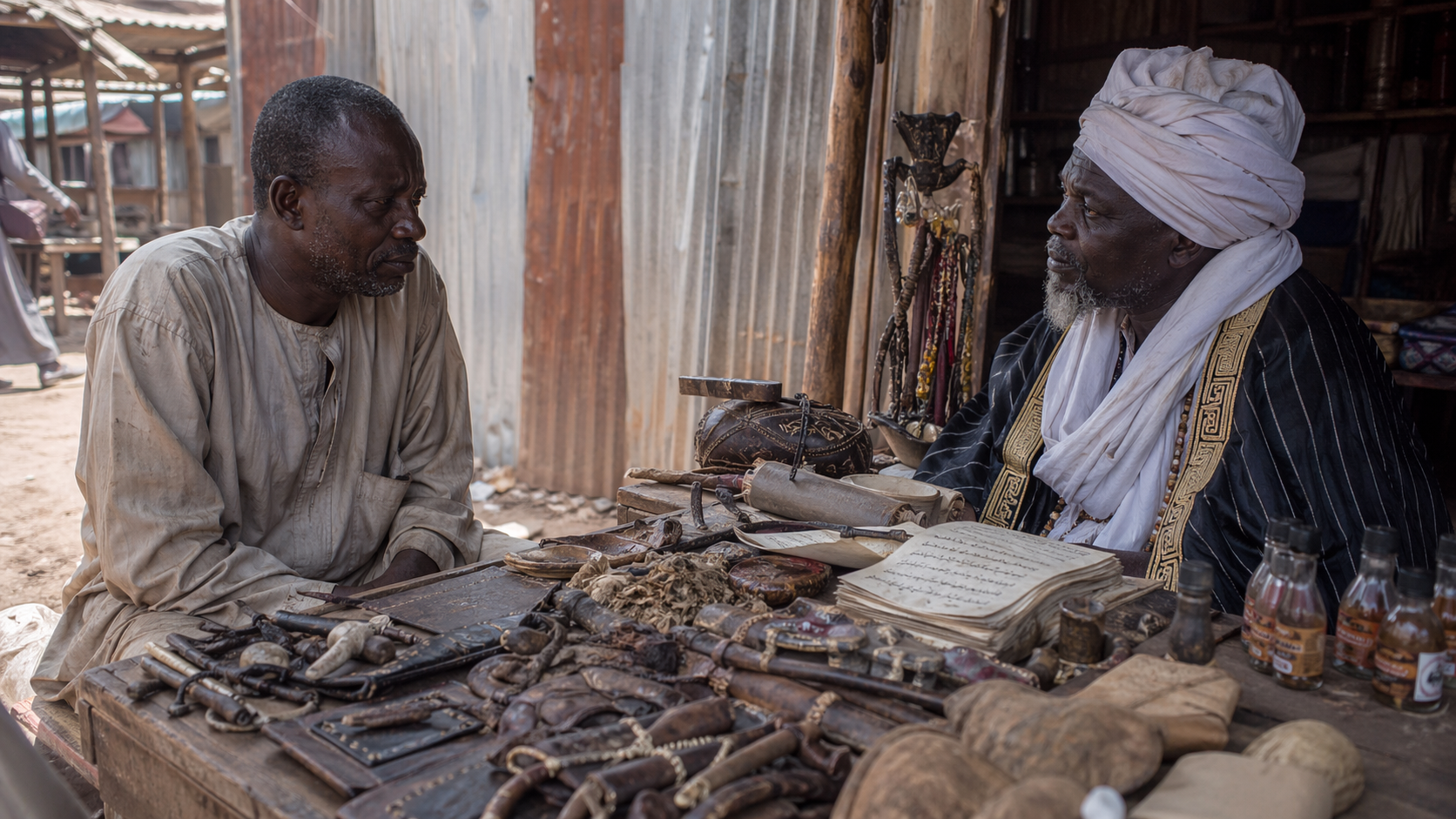
In any major market in Kano, Bauchi, Sokoto, or Zaria, you will find them. They sit under shade, surrounded by bottles, roots, papers covered in Arabic script, and leather pouches.
They dress well. Their phones are charged. Their children go to school.
Now look at who comes to them.
A woman whose husband is ill and cannot work. A young man who has failed his exams three times and believes something invisible is blocking him. A widow told that her co-wife placed a curse on her business. A mother carrying a child whose sickness the clinic could not explain or whose bill she simply could not pay.
These are not foolish people. They are desperate people. And desperation is exactly the product these men understand best.
The layu costs ₦5,000. The special rubutu costs ₦15,000. The full “permanent cure” costs ₦50,000 or more. Payment comes in stages — so the client keeps returning before realizing no cure will ever arrive.
How the System Works
These practitioners do not improvise. They operate a deliberate method.
They build trust first. A mallam spends weeks in a neighborhood giving small favors, speaking gently, performing the image of a man of knowledge. By the time money is requested, the client already believes.
They manufacture the problem. A client arrives worried about his failing business. The mallam listens, then announces: “Someone has buried something near your house. That is the source of your problems.” The client never mentioned buried objects. Now he is terrified and willing to pay to remove something he cannot see, touch, or verify.
They extend the treatment. When the first layu fails, the explanation is always ready: the curse is stronger than expected, or the client did not follow instructions correctly. Another payment is needed. Then another. The goalpost never stops moving.
They use social proof. When one person in a community claims success after visiting a mallam, ten more follow. Nobody publicly announces that they paid and received nothing shame keeps failures silent, and the business continues.
What This Costs the Community
This is not a minor inconvenience. It is a systematic drain.
Across Northern Nigeria, millions of naira flow annually from the pockets of talakawa (the common poor) into the hands of unregulated spiritual merchants. A family that spends ₦50,000 on layu has lost school fees. A farmer who pays for rubutu instead of fertilizer has already reduced his harvest before the planting season begins.
Poverty does not lift. It deepens because money spent on invisible solutions is money taken away from real ones.
These practitioners face zero regulation. No licensing. No government oversight. No accountability to anyone. If a client is harmed financially, physically, or psychologically there is no formal recourse. The mallam simply moves to the next market.
The system is designed to extract. And it works perfectly.
The Freethinker’s Solution
Complaining without direction is easy. Here is the direction.
1. Name It for What It Is
Charging money for guaranteed outcomes in matters no human being can control is fraud. It is not culture. It is not tradition. It is not spirituality. Communities that name it clearly make it harder for practitioners to operate in the open.
2. Economic Literacy Is the Real Amulet
The farmer who understands crop rotation, soil management, and market pricing does not need layu for his farm to produce. The young man who acquires a skill does not need rubutu to open doors. Real prosperity has a process one that can be taught, learned, measured, and repeated. Invisible forces cannot compete with visible results.
3. Cooperative Investment Over Spiritual Spending
What a family spends on multiple visits to a spiritual merchant could instead enter a community savings group adashe (a rotating cooperative where members pool and share funds) where it grows and returns. Cooperative models have helped communities across Northern Nigeria fund small businesses, build infrastructure, and support families during hardship. These systems are transparent. Results are measurable. Nobody drives away in a new car while members go hungry.
4. Demand Evidence From Everyone
We ask politicians to account for public money. We ask traders to show receipts. We must extend the same standard to anyone who collects money in exchange for a promised result.
What exactly does this layu do? By when? How will we know if it worked? These are not disrespectful questions. They are the only rational questions. Anyone who cannot answer them has no business taking money.
The Real Blessing
The talakawa (common people) of Northern Nigeria are not poor because of curses. They are poor because of structural failures broken infrastructure, inaccessible healthcare, poor quality education, and limited economic opportunity.
No leather pouch reverses a policy failure. No rubutu repairs a broken market.
The day a community redirects the money it spends on spiritual merchants into savings, education, and cooperative investment that is the day real change begins.
That is the only blessing with a proven track record.