Every week we slip a brand-new brain-teaser under your mental door, no subscription to dogma required. Each solution is a wink to the great tradition of freethought: one week you’ll crack a code that spells “Spinoza,” the next you’ll untie a knot labeled “Skepticism.” Think of it as intellectual cardio for anyone allergic to sacred cows. Stretch, twist, and, if necessary, overthrow your assumptions; the only rule here is that there are no unquestionable rules. Ready to liberate a few neurons?
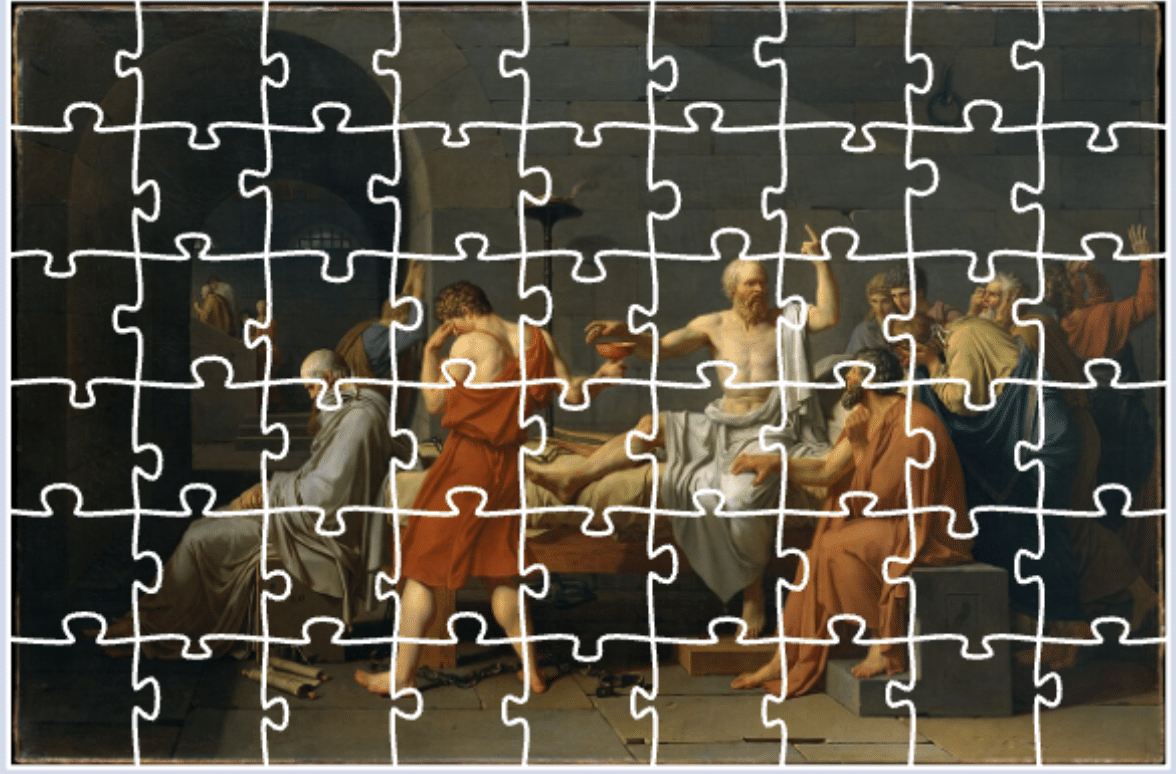
Jigsaw – The Death of Socrates – puzzle #4
You like making puzzles? Here are some more.
The Hidden Stories Behind David’s “Death of Socrates”: Secrets Revealed by Modern Technology
When Jacques-Louis David unveiled “The Death of Socrates” at the Paris Salon of 1787, critics were stunned. Sir Joshua Reynolds, one of Britain’s most influential painters, visited the exhibition nine times just to see this single work, eventually declaring it “in every sense perfect” and comparing it to masterpieces by Michelangelo and Raphael. But what Reynolds and his contemporaries couldn’t see were the hidden layers of meaning, the artistic struggles, and the secret changes that modern technology has now revealed.
The Painting That Predicted Revolution
David’s masterpiece depicts the final moments of the Greek philosopher Socrates in 399 B.C., as he prepares to drink the cup of hemlock rather than renounce his beliefs. The 71-year-old philosopher, condemned for “impiety and corrupting the youth,” sits surrounded by his distraught followers, calmly discoursing on the immortality of the soul even as death approaches.
But this wasn’t just a historical painting, it was a powder keg. Created just two years before the French Revolution, the work became an unexpected rallying cry for revolutionary ideals. Socrates’ principled defiance of corrupt authority resonated powerfully with pre-revolutionary audiences. Ironically, David himself would later become deeply involved in the Revolution, even voting for the execution of King Louis XVI. The painting that celebrated noble sacrifice for one’s beliefs would witness how “revolutionary fervor can become simply murderous,” as one modern art historian noted.
The Mystery of the Double Signature
Most viewers walk past one of the painting’s most intriguing details: David signed his name twice, and each signature carries symbolic weight. His full signature appears under Crito, the young man desperately clutching Socrates’ thigh, while his initials are placed beneath Plato, the elderly figure at the foot of the bed. This wasn’t mere artistic whim, David’s signature placements always held meaning.
The initials under Plato acknowledge that the story comes from Plato’s dialogue “Phaedo,” serving as a thank-you to his ancient source. The fuller signature under Crito reveals something more personal: this is the character David identified with most. Crito represents the devoted follower who cannot bear to lose his teacher, perhaps David saw himself as a devoted student of classical ideals.
The Figure Who Wasn’t There
Here’s a detail that escapes most viewers: Plato, sitting pensively at the foot of the bed, was not actually present at Socrates’ death. The historical Plato was ill that day. David included him anyway, but with a brilliant artistic solution. Rather than simply ignoring historical accuracy, David painted Plato as an old man lost in memory, reimagining and retelling this crucial moment from his past. The painting becomes not just a historical scene, but Plato’s act of remembrance, we experience Socrates’ death through the philosopher who would immortalize it in writing.
Hidden Figures Revealed by X-Rays
The most startling discovery came when The Metropolitan Museum of Art subjected the painting to macro X-ray fluorescence scanning in preparation for a 2022 exhibition. The technology revealed hidden figures that David had painted over: a cloaked woman carrying a small child on the stairs in the background. The child appears to be reaching back toward the scene while clinging to the woman’s neck.
These ghostly figures are likely Socrates’ wife Xanthippe and their youngest son, who according to Plato’s account was small enough to be carried in his mother’s arms. David ultimately decided to remove this family group, perhaps feeling their presence would distract from the philosophical gravitas of the scene. Instead, only a single distant female figure, presumably Xanthippe, appears on the background stairs, taking “a wistful glance backward.”
The Architect’s Precision
David’s preparation for this painting was obsessively methodical. X-rays reveal a tiny hole made by a stylus at the vanishing point of his single-point perspective system, positioned precisely over Plato’s head. David likely used chalk-covered strings snapped against the canvas to create his perspective lines, ensuring that viewers’ eyes would be inevitably drawn to the source of the narrative.
Every element was calibrated for maximum emotional impact. Infrared imaging shows that David continuously refined Socrates’ hand position, initially painting his fingers extended toward the cup before adjusting them to a more relaxed pose, a subtle change that better conveyed the philosopher’s serene acceptance of death.
The Window That Disappeared
In his early sketches, David included an oculus window behind Socrates, but he painted over it in the final version. The iron-based paints show up clearly in modern scans, revealing this architectural feature that David ultimately deemed too distracting. Instead, he left only a small ring and hook on the wall, a more austere backdrop that focuses attention on the human drama.
Perfection Through Subtraction
Perhaps the most striking aspect revealed by modern analysis is how David achieved his masterpiece through what he removed rather than what he added. A hairband on one disciple disappeared because it was too distracting. Chains were repositioned to flow more naturally. Even the canvas itself was extended slightly so that the anguished disciple at the far right could be shown with his full arm rather than cropped, a small change that dramatically increased the emotional impact of his grief.
The Revolutionary’s Dilemma
The painting’s afterlife proved as complex as its creation. David’s celebration of noble sacrifice for principle would later haunt him as the Revolution he supported descended into the Terror. The same artist who painted Socrates’ dignified defiance of death would create propaganda for Robespierre and witness the execution of thousands. The Death of Socrates stands as both an artistic triumph and a reminder of how ideals can be transformed by the harsh realities of political action.
A Living Masterpiece
Today, modern technology continues to reveal new secrets within David’s masterpiece. Each scan, each analysis provides fresh insights into the artist’s creative process and the painting’s rich symbolic layers. What appeared to be a straightforward historical scene proves to be a complex meditation on memory, sacrifice, and the price of standing by one’s beliefs.
When you next encounter “The Death of Socrates” at The Metropolitan Museum of Art, remember that you’re seeing not just the surface of a painting, but layers of artistic decision-making, political commentary, and philosophical reflection. You’re witnessing David’s obsessive pursuit of perfection, his hidden tributes to ancient sources, and even the ghostly presence of figures he ultimately decided to erase. In the end, perhaps the painting’s greatest achievement is how it transforms a moment of death into a testament to the enduring power of ideas, and the complex relationship between art and the turbulent times that shape it.