Scientific explanations for no Devil: Why a Pope couldn’t have overseen him
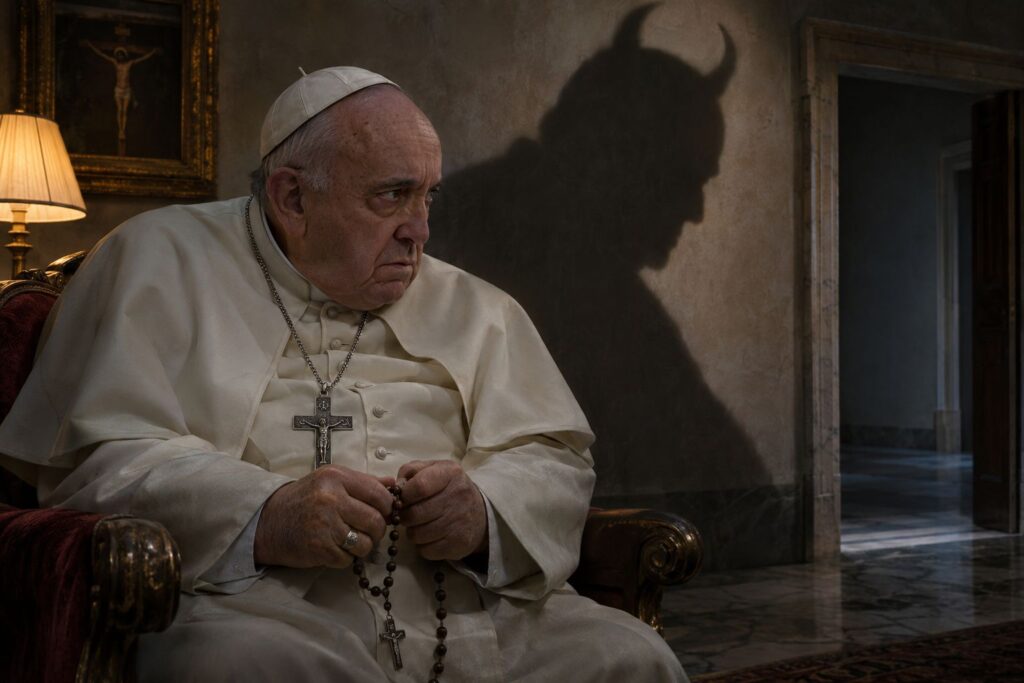
The posthumous diary of Pope Francis has given the world a vivid spiritual horror story: the devil “from the car” with “menacing eyes”; the devil in the choir loft; the devil in Rome after the Chile abuse crisis, rasping triumphantly, “Now I’ve gotten everything I wanted”; and, in June 2018, the gates of hell themselves, which the pope said he peeked into before grabbing his rosary “as a weapon.” The accounts are dramatic and deeply human. They are also exactly what one would expect if there were no devil at all.
Published on November 24, 2026, the book presents selected diary passages with editorial commentary. The car and choir-loft encounters preceded Francis’s papacy; the car episode was recalled in January 2021 as having happened roughly fifteen years earlier. His June 7, 2018, entry about hell described the previous night, while he was preparing to sleep. These are personal accounts, not new Catholic doctrine: the Church itself says private revelations do not belong to its deposit of faith.
The sharpest way to put the problem is this: there is no devil, yet the pope saw him. A being with no independently verified physical effects, no consistent cross-religious identity, no explanatory necessity, and no independently corroborated appearances somehow kept appearing to the man who led the Catholic Church. That is not proof of Satan. It may illustrate how powerfully the idea of Satan works on a mind under pressure.
The natural world has no demon-shaped hole
Illness was once the devil’s favorite workshop. Epilepsy, psychosis, trance states, hearing voices, sudden violence—all have been read as possession in particular religious and cultural settings. Today psychiatry and neuroscience offer explanations involving brain activity, trauma, dissociation, and environmental stress. A 2014 study in Current Biology induced the feeling of another person’s presence in healthy participants by creating conflicting sensory and movement signals. A 2021 study in PNAS, involving more than 2,000 participants across five countries, found that cultural ideas about the mind and individual tendencies toward absorption were associated with reports of spiritual presence. Neither study establishes what happened to Francis, but both help explain why an experience can feel real without independently establishing a supernatural cause.
Cardinal Víctor Manuel Fernández, the editor of Francis’s diary, acknowledged that the pope’s visions could be interpreted as “products of his own imagination.” He nevertheless gave them a spiritual interpretation, not a clinical diagnosis. Experiences perceived as real sensory events without an external stimulus can be described as hallucinations, but a diary alone cannot establish that diagnosis. Hallucinations can also occur around falling asleep or waking and do not necessarily indicate a psychiatric disorder.
Meteorology and geology follow the same pattern. Thunder, hail, drought, storms, earthquakes, volcanic eruptions, and plagues were once assigned to aerial spirits, subterranean demons, or divine punishment. The Brocken Spectre—an optical effect named after the Brocken in the Harz Mountains—was once associated with malevolence and foreboding. It is an observer’s shadow projected onto cloud or mist. Today atmospheric physics explains storms, plate tectonics explains earthquakes, volcanology explains eruptions, and epidemiology explains plagues. No established scientific explanation requires a demon. The devil has been evicted from one domain after another not because science is ideologically naturalistic, but because natural explanations predict, retrodict, and cohere. Demonic explanations have demonstrated no comparable predictive success.
We can add neuroscience, psychiatry, sleep paralysis, pareidolia, confirmation bias, coincidence, grief, stress, and the psychology of power. None of these requires a spiritual agent. Such mechanisms can produce vivid experiences without an external agent; that does not establish which, if any, explains a particular episode.
No evidence, no force, no logic
If a devil existed and acted in the world—tempting, accusing, causing illness, manipulating weather, inciting abuse and cover-up—we should expect independent evidence. We have no independently verified evidence of a demonic cause. No instrument has reliably recorded a spiritual force. No experiment has reproducibly isolated a demonic influence. Modern physics describes four known fundamental interactions: gravitation, electromagnetism, the strong nuclear force, and the weak nuclear force. A disembodied being that can move matter, alter brains, or change weather would need to produce physical effects. Nothing in our established physical laws requires a devil, and even our most sophisticated instruments have produced no independently verified evidence of demonic intervention. That does not prove the nonexistence of every conceivable devil, but for a being alleged to interfere so extensively with the physical world, that absence of evidence makes the claim deeply dubious.
The logic is worse. An explanation that can accommodate every possible outcome—illness and recovery, catastrophe and escape—offers little unless it makes predictions that distinguish it from alternatives. Catholic teaching already treats Satan as a finite creature with limited power, so neither his limitations nor medicine’s successes contradict that doctrine. The question is what independently testable explanatory work he does. The devil explains too much and accounts for too little.
Different devils, same human function
Religions do not converge on one consistent account of a cosmic adversary. In Islam, Iblis is identified in the Quran as one of the jinn who rebels against God. In Catholic Christianity, Satan is a fallen angel; in the Book of Job, the satan appears as an accuser within the heavenly court. In Buddhist traditions, Mara can be a personified tempter or a symbol of obstacles to liberation, including attachment and desire. The demon of Mark is portrayed as hostile; the Korean gwisin is commonly a ghost or spirit of the dead; Hindu demonology includes Ravana but also varied and sometimes ambivalent portrayals of beings translated into English as demons. These are not interchangeable categories. Some cultures’ spirits are blamed for disease; others are approached for healing.
These are not evidence of one revealed truth. They are different narrative technologies for managing suffering, moral failure, and uncontrollable tragedy. Their diversity does not by itself prove that no such being exists. The cross-cultural pattern is exactly what we would expect if “the devil” were a human construct—flexible, local, and useful—rather than a single being revealing himself consistently across history.
Why so many still believe
Human cognition can be biased toward agency. When illness strikes, when storms destroy, when abuse is uncovered, positing an invisible agent with plans and malice is cognitively satisfying. It turns meaningless suffering into meaningful conflict. It provides a who to blame and sometimes a how to resist. As the philosopher Stephen Law puts it, belief in invisible agents offers “quick, convenient explanations” and “the illusion of control.” It is social, emotional, and consoling. For a pope under the weight of a sexual-abuse crisis, a devil who says “Now I’ve gotten everything I wanted” is not independently verified evidence of Satan; it may reflect a conscience, a crisis, and a religious imagination under extreme strain.
Pope Francis’s visions may have been spiritually real to him. But spiritual reality is not empirical evidence of an external being. A pope’s sincerity does not make a disembodied adversary detectable. His office does not turn a personal experience into independent physical evidence. And the fact that many people believe in some devil—different devils, contradictory devils, devils who explain whatever needs explaining—is evidence of the human mind’s appetite for such stories, not proof that the stories are true.
There is no devil. Yet the pope saw him. That apparent contradiction is not a mystery of faith. It is a diagnosis of belief.