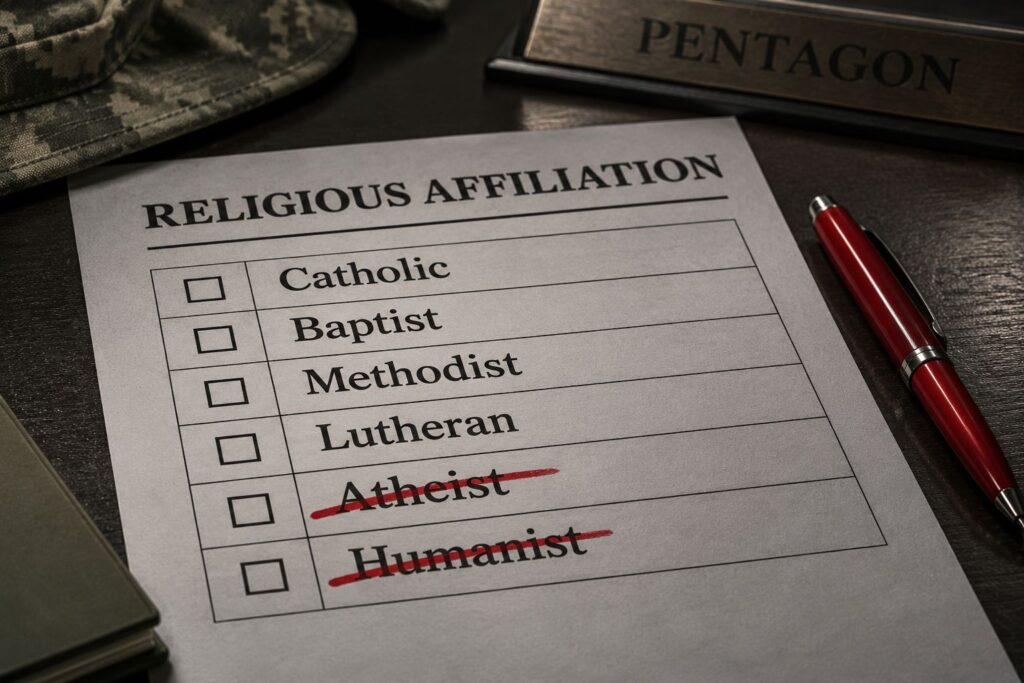
The Pentagon erased atheist identities. Now it faces a lawsuit
Atheists serve in the American military. Their government should be able to acknowledge that without treating their identity as an administrative inconvenience.
On October 30, American Atheists announced a federal lawsuit seeking records about the Pentagon’s removal of 180 religious identification codes, including those for atheists, humanists, and Unitarian Universalists. According to the organization, changes announced by Defense Secretary Pete Hegseth reduced the available categories from 211 to 31, with Christian denominations accounting for two-thirds of the remaining options.
Whose identity counts?
The Pentagon’s stated justification, as reported by American Atheists, is administrative efficiency: the previous list was unwieldy, and standardized categories would help military chaplains understand personnel and allocate support. The organization argues that removing minority identities undermines precisely that goal.
That objection deserves an answer. How does a system become more accurate by giving people fewer ways to describe what they actually believe—or do not believe?
There is nothing inherently wrong with simplifying bureaucracy. But efficiency becomes a poor defense when the resulting system preserves numerous distinctions within Christianity while eliminating recognition of people outside it.
An atheist is not an incomplete Christian. A humanist’s convictions are not an administrative error. Neither should have to disappear into a category that obscures their identity for the convenience of officials.
A lawsuit demanding answers
This lawsuit seeks disclosure, rather than directly asking a court to overturn the classification policy. American Atheists says the Defense Department had produced no records in response to its earlier Freedom of Information Act request. It wants the court to require a search and release of responsive, nonexempt documents.
The distinction matters. The announcement does not establish that a court has found discrimination. It establishes that the organization is seeking the information needed to scrutinize a consequential government decision.
Service does not require faith
Military personnel should not have to share their defense secretary’s religion to receive equal recognition and consideration.
A secular military can accommodate religious belief while respecting nonbelief. Its responsibility is to the people who serve, including those who find meaning, moral responsibility, and solidarity without a god.
The Pentagon should explain whose interests this change serves. Administrative tidiness is not a convincing answer to people whose identities have been removed from the list.