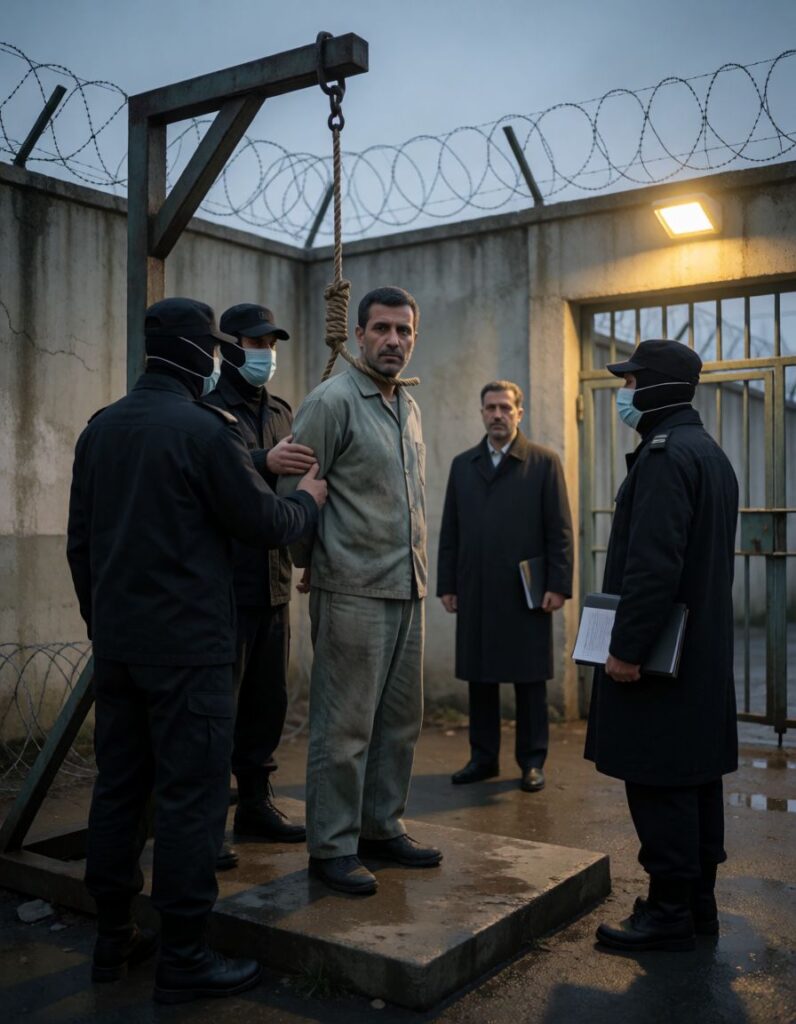
“Corruption on Earth”? In Iran, a death sentence
Amirhossein Mousavi wrote online under a name meaning “James without faith.” Now he faces execution.
His lawyer, Reza Shafakhah, confirmed on November 4 that an Iranian court had sentenced him to death for “corruption on earth” in connection with his social media activity. Authorities identified the man behind the anonymous account and arrested him at a Tehran airport in December 2024. Almost two years later, his online dissent has become a capital case.
The phrase sounds like a sweeping moral judgment. In this case, it gives the state the power to kill a critic while presenting itself as the defender of society.
A death sentence—and five years for offending religion
According to the human rights organization Hengaw, Branch 15 of Tehran’s Revolutionary Court, presided over by Judge Abolqasem Salavati, sentenced Mousavi to death and imposed an additional five-year prison term for “insulting religious sanctities.” He was notified of the sentences in Evin Prison.
The prosecution’s allegations went beyond offensive posts. Hengaw reported that he faced nine charges, including forming a group against national security, exchanging information with people allegedly affiliated with Israel, and financing terrorism. These accusations must be distinguished from independently established facts. His lawyer links the case to his online activity, while Mousavi has rejected the state’s portrayal of him.
That distinction matters. The case should not be simplified into a claim that Iran formally sentenced him to death merely for being an atheist. But neither should the words “national security” be accepted as proof that a prosecution is legitimate.
And the additional punishment for insulting religious sanctities deserves condemnation in its own right. Religious beliefs should be open to criticism, ridicule, and rejection. Protecting people from violence is a legitimate responsibility of government. Protecting sacred ideas from offense is no justification for imprisonment.
A televised confession, challenged from prison
Iran Human Rights reports that Mousavi endured 148 days in solitary confinement, beatings, and pressure involving the detention of his ill wife. His purported confession appeared on state television in October 2025, before his trial began.
In a statement from prison, Mousavi said interrogators dictated his recorded statements and that the broadcast then distorted them through selective editing. He denied the espionage narrative presented to viewers. His lawyer also challenged the broadcast and said the recording had been obtained under pressure connected to securing his wife’s release on bail.
These are allegations requiring independent investigation. They are also precisely the kinds of allegations that make an irreversible punishment indefensible.
A televised confession cannot substitute for a fair trial. Viewers cannot cross-examine an interrogator, inspect the unedited recording, or determine what threats preceded the camera being switched on. When the accused says his family was used to force his cooperation, broadcasting his words does nothing to resolve whether those words were freely spoken.
Iran’s killing machine keeps operating
Mousavi’s sentence comes amid a continuing procession of executions.
Iran Human Rights documented at least 691 executions between January 1 and October 31, 2026, including 77 in October alone. The ten-month total included 23 women and three men who were under 18 at the time of their alleged offenses.
The organization recorded 244 executions for drug-related offenses and 81 on security-related charges. Across its categories, it identified 36 people executed in connection with protests.
Only 100 of the 691 executions were announced by official sources. The organization says it independently verified the others. These figures are a documented minimum through October 31, not a complete total for November.
The killing has continued since that cutoff. On November 8, Reuters reported that Iran executed Hassan Dioband, Hamid Kazemi, and Reza Zanganeh following convictions connected to January’s anti-government unrest. The judiciary accused them of armed attacks, damage to public facilities, and operations for Israel and the United States. Reuters attributed those allegations to Iranian authorities; its report did not independently establish them.
The distinction between allegations and verified conduct remains essential. So does a broader principle: opposition to execution cannot depend on every prisoner being innocent, politically sympathetic, or accused only of peaceful speech. People convicted of serious crimes also retain their humanity. Accountability does not require killing them.
Who is corrupting society?
A government that claims to defend morality should be judged by how it treats people in its custody. It should have to answer allegations of torture, allow meaningful scrutiny of prosecutions, and protect the right to challenge its authority.
Calling someone a source of “corruption on earth” answers none of those demands. The grandeur of the accusation cannot repair unreliable evidence or justify punishment for offending religion.
Mousavi’s death sentence should be overturned. Allegations of coercion should be independently investigated, and anyone imprisoned solely for peaceful expression should be released. Iran should halt executions as a step toward abolishing the death penalty.
The state does not demonstrate its moral authority by killing those it condemns. A system that threatens a critic with death while punishing religious offense has far more urgent questions to answer about its own conduct.