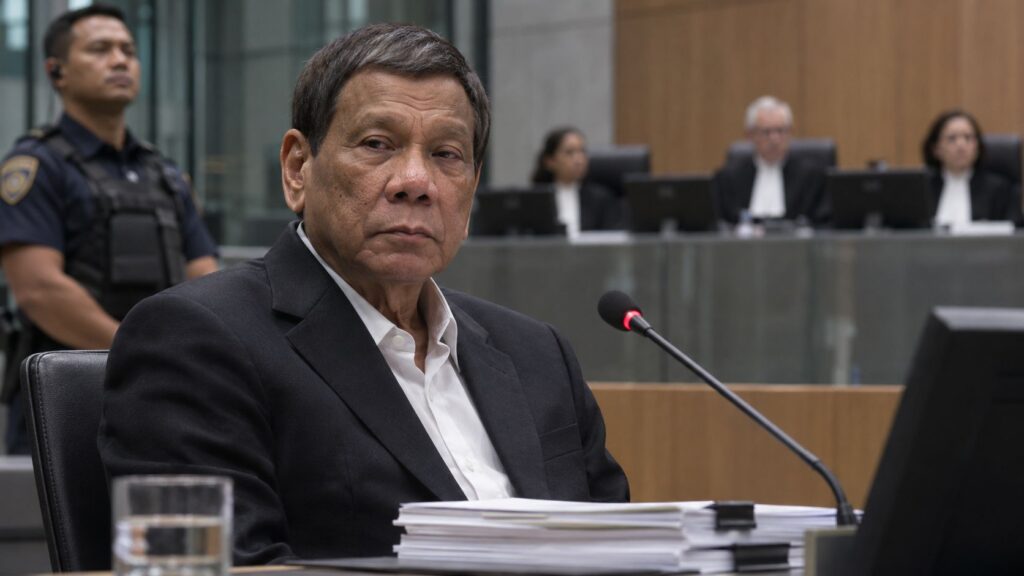
Duterte faces trial: His War on Drugs left thousands dead
Rodrigo Duterte promised to rid the Philippines of drugs and crime. His campaign left thousands dead, families demanding answers, and a question that no appeal to public safety can erase: who gave the state permission to turn suspicion into a death sentence?
On November 30, the former Philippine president is scheduled to go on trial at the International Criminal Court in The Hague, charged with murder and attempted murder as crimes against humanity. The proceedings concern an alleged widespread and systematic attack on civilians connected to the country’s “war on drugs.”
Duterte’s individual criminal responsibility must be proved in court. The broader moral question is already clear. A government cannot establish respect for the law by giving its agents permission to kill people outside it.
The promise of a quick solution
The political appeal of a ruthless anti-drug campaign is easy to understand. People want protection from violent traffickers, intimidation, addiction, and the damage these inflict on their families. Where institutions are corrupt or ineffective, promises of immediate action can sound more convincing than another pledge of reform.
Duterte offered an especially brutal answer. During his rise to the presidency, he openly threatened drug dealers and users with death. Human Rights Watch documented repeated statements encouraging killings and dismissing human rights objections.
But eliminating drug trafficking and eliminating people accused of involvement in drugs are radically different projects. One requires evidence, investigations, functioning courts, and attention to the conditions sustaining the market. The other requires weapons and someone willing to name a target.
An accusation becomes particularly dangerous when those making it also control the crime scene and write the official account of the death.
What happened behind the slogans
The documented abuses went far beyond abstract concerns about excessive force.
Human Rights Watch’s 2017 investigation examined 24 incidents involving 32 deaths. It found that police accounts invoking self-defense conflicted with witnesses’ descriptions of unarmed suspects being killed. Investigators also documented the planting of guns, ammunition, and drugs to support official explanations.
A separate Amnesty International investigation, based on 110 interviews and 33 documented cases, found extrajudicial executions implicating police, disproportionate targeting of poor people, and evidence that some supposedly unidentified gunmen were assassins paid by police officers.
These findings describe a system in which unlawful killing could be disguised as successful law enforcement.
Nor can every victim simply be relabeled a convicted trafficker. The campaign targeted suspected users as well as alleged sellers. Being identified by an informant, placed under suspicion, or described afterward as a “drug personality” is not a judicial finding of guilt.
The official police tally acknowledged 6,252 deaths in anti-drug operations between July 2016 and May 2022. Broader estimates cited by human rights organizations reach around 30,000. These figures cover different categories and methods of counting; the higher estimate should not be presented as a settled official total.
The uncertainty over the final number does not erase the documented killings. Nor does it make each individual death less deserving of investigation.
Even guilty people have rights
The strongest objection to Duterte’s campaign does not depend on proving that everyone killed was innocent.
Even someone who sells drugs retains human rights.
That person may deserve investigation, arrest, prosecution, and a proportionate sentence following conviction. A violent offender may need to be restrained to protect others. But criminal involvement does not authorize the police to execute a person who poses no immediate threat to life.
There is a crucial difference between force necessary to stop an imminent lethal attack and killing someone as punishment for an alleged offense.
Without that distinction, “fighting crime” becomes an unlimited permission slip. Officials can invoke the label of criminal to evade scrutiny, while the dead lose any opportunity to contest the accusation.
Human rights protections are most necessary when the person invoking them is unpopular. If they apply only to people the government approves of, they are privileges granted by power.
The public also has a direct interest in these limits. A system that can kill a guilty person without proving guilt can kill an innocent person in exactly the same way.
A body count is not evidence of success
Defenders of extreme crackdowns often demand a simple answer: did they make people safer?
That is a legitimate question. Counting bodies does not answer it.
A serious assessment would examine violent crime, drug-related harm, the strength of trafficking organizations, corruption, and the security of ordinary residents. It would also include the violence committed by the authorities themselves. A government cannot honestly measure public safety by excluding its own unlawful killings.
Even a documented decline in some offenses would not automatically show that executions caused it, that less destructive policies could not have achieved it, or that the gains outweighed the harm.
There is also a basic investigative problem. Killing a suspected street-level seller cannot substitute for tracing suppliers, financial flows, corrupt protection, and the people directing the business. A dead suspect cannot testify against a superior.
A credible drug policy should combine accountable enforcement against violence and trafficking with accessible treatment and prevention. It should be judged by the harm it reduces, rather than the fear its officers inspire.
What the ICC must decide
The case reaches back beyond Duterte’s presidency to killings allegedly committed during his time as mayor of Davao City.
The confirmed charges cover alleged murders in Davao during the mayoral period, killings of people designated as high-value targets during the presidency, and murders and attempted murders associated with neighborhood clearance operations.
This is not a trial of every death attributed to the entire drug war. It concerns specified charges and Duterte’s alleged responsibility for them.
He was surrendered to the ICC in March 2025. The court confirmed the charges in April 2026. Confirmation allowed the prosecution to proceed; it was not a conviction.
At trial, the prosecution must establish guilt beyond reasonable doubt. Duterte must be able to challenge witnesses, contest evidence, and present his defense. Those protections matter even when the allegations are appalling.
Indeed, applying them is essential to the legitimacy of the proceedings. The answer to alleged state brutality must be a process governed by evidence and law.
The rights the dead were denied
One trial cannot provide justice for every family, expose every perpetrator, or repair institutions that failed to protect people. Accountability also requires credible domestic investigations, protection for witnesses, and meaningful remedies for victims.
But trying a former president challenges the assumption that political authority can place a person beyond the reach of criminal law.
Duterte is entitled to a fair trial. So were the people killed under the banner of his drug war.
A government’s duty to protect the public includes protecting it from criminals in uniform. When killing without trial becomes an instrument of policy, the state becomes another source of the violence it promised to end.
The dead cannot defend themselves. Duterte can. That is what the rule of law requires.