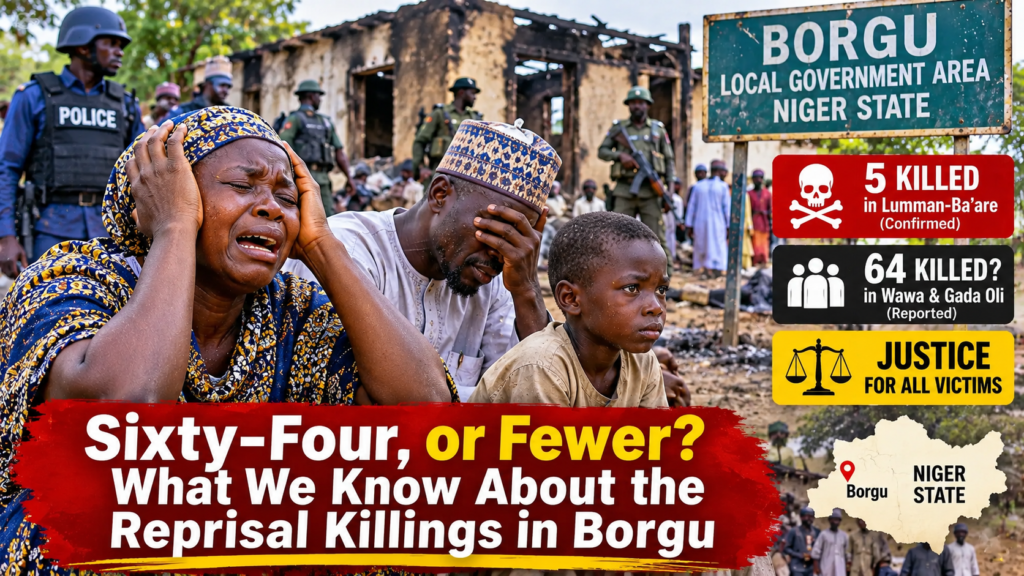
Sixty-Four, or Fewer? What We Know About the Reprisal Killings in Borgu
On Saturday, 21 November 2026, armed assailants attacked a rural settlement in Borgu Local Government Area of Niger State.
By Sunday, dozens more people were reported dead across two neighbouring communities.
Amnesty International Nigeria has called for an immediate and impartial investigation. Police and state officials have confirmed elements of the initial attack, while accounts of the subsequent killings remain contested. This article sets out what is officially established, what has been reported by local sources and rights groups, and what remains unverified.
The initial attack
Around 5:00 a.m. on Saturday, 21 November, suspected armed men raided Lumman-Ba’are village, according to the Niger State Police Command. Police spokesman SP Wasiu Abiodun stated that about five people were killed and several houses were set ablaze.
The Niger State Government also confirmed the raid. The Commissioner for Information, Obed Nuhu Nana, condemned the attack and stated that five people, including the village head, Mallam Bawa Muhammad, lost their lives.
Media reports by Daily Trust and ThePoint indicated that the village head’s wife and three of his children were among those killed. Those additional details stem from press accounts rather than a broader official tally.
Reported reprisals
Accounts diverge sharply over what followed the raid on Lumman-Ba’are.
A community source in Wawa told Daily Trust that vigilante groups mobilised in large numbers after a captured suspect allegedly claimed the attackers originated from Gada Oli, roughly 70 kilometres away. According to that account, armed groups headed toward Gada Oli to carry out a “sanitisation” operation and opened fire along the route, including in Wawa.
Ardo Umar Lapai, the Niger State chairman of the Miyetti Allah Cattle Breeders Association of Nigeria (MACBAN), stated that at least 64 Fulani residents were killed in reprisal attacks across Wawa and Gada Oli between Saturday and Sunday. A resident of Wawa told Daily Trust that 38 bodies were buried in Wawa on Sunday morning in the presence of the Emir of Borgu, adding that he did not know the toll in Gada Oli.
Sahara Reporters published accounts alleging that worshippers, including children, were killed inside a mosque at Gadan Oli, while noting that police had not confirmed the report.
Amnesty International Nigeria stated that it had reviewed photographs and videos from the aftermath and described the incidents as reprisal attacks in which women and children were killed in their homes, urging authorities to investigate and prosecute all perpetrators.
Established facts versus contested claims
| Claim | Current Status |
| Armed raid on Lumman-Ba’are on 21 November 2026 | Confirmed by Niger State Police Command and state government |
| Five deaths at Lumman-Ba’are, including the village head | Confirmed by police and state government |
| Reprisal attacks in Wawa and Gada Oli (Gadan Oli) | Reported by community sources, MACBAN, and Amnesty International; police have not confirmed details |
| At least 64 killed in reprisals | Claimed by MACBAN and cited in media reports; unconfirmed by police |
| 38 buried in Wawa on Sunday | Reported by a Wawa resident to Daily Trust |
| Mosque killings at Gadan Oli | Reported by Sahara Reporters; unconfirmed by police |
Some press accounts have cited unverified death tolls ranging between 35 and 64. Until security agencies and state authorities release a comprehensive, verifiable accounting, the honest conclusion is that the casualty figure is disputed and could be higher or lower than 64.
Two separate wrongs
The attack on Lumman-Ba’are was a serious crime. Villagers, including their traditional head, were killed in their own home.
If the reported reprisals occurred as described, those killings were also serious crimes. Targeting residents because of their perceived ethnic identity turns innocent civilians into collective targets for acts committed by others.
Both statements can stand together. Condemning the raid on Lumman-Ba’are does not excuse killings in Wawa or Gada Oli, and condemning reprisal killings does not minimise the initial attack. A claim attributed to a captured suspect about where attackers came from is a lead for investigators, not a warrant for collective punishment against an entire community.
Constitutional and criminal standards
Nigerian law sets clear boundaries on the use of lethal force and accountability:
* Right to Life: Section 33(1) of the 1999 Constitution protects the right to life and allows deprivation of life only in execution of a court sentence for a criminal offence of which a person has been found guilty.
* Presumption of Innocence: Section 36(5) presumes every person charged with a criminal offence to be innocent until proven guilty, which leaves no legal room for summary or collective punishment.
* Non-Discrimination: Section 42 protects citizens against discrimination based on ethnic group or place of origin.
Under Nigerian criminal law, unlawful killing is homicide regardless of motive or retaliation. In August 2026, the Inspector-General of Police directed state commissioners to treat mob violence as homicide. Whether armed vigilante mobilisations operating openly fall under that directive, and how the police enforce it, is a central question of law enforcement.
Amnesty International has also emphasised that failing to investigate and prosecute mass killings breaches obligations under international human rights law.
A wider pattern of insecurity
The events in Borgu fit a broader pattern of instability affecting rural communities across parts of Niger State, including Borgu and Agwara local government areas.
MACBAN has urged state authorities to curb escalating violence in the Borgu and Agwara corridor. Amnesty International has warned that cycles of retaliatory attacks and weak state protection erode public order, creating space for armed groups to raid settlements, kidnap residents for ransom, and kill with impunity.
The Niger State Government has pledged to protect lives and property regardless of ethnic, religious, or communal background. Credibility on that pledge depends on impartial investigations and prosecutions against perpetrators on every side.
Questions the record can answer
Moving from conflicting reports to accountability requires answers to six specific questions:
* Initial Attack: Who carried out the raid on Lumman-Ba’are, and have any suspects been arrested?
* Armed Vigilantes: Who mobilised, armed, or coordinated the vigilante groups that moved toward Wawa and Gada Oli, and under what legal authority did they act?
* Casualty Discrepancy: Why has the confirmed official death toll remained at five while community leaders and rights observers report dozens more?
* Independent Inquiry: Will the state government or security agencies establish an independent, transparent inquiry into both the initial attack and the alleged reprisals?
* Victim Protection: How many displaced survivors need shelter, medical care, or security protection, and where are they currently located?
* Enforcement of Directives: Has the Inspector-General’s August 2026 directive treating mob killings as homicide been actively applied in this case?
Answering these questions does not require partisan loyalty, ethnic alignment, or religious bias. It requires verifiable records from security agencies, hospitals, local authorities, and the courts.
If community tallies are accurate, dozens of people were buried over a single weekend. If they are inflated or incomplete, official records are the proper way to establish the truth. Either way, families across Borgu are waiting for clear answers and equal justice under the law.