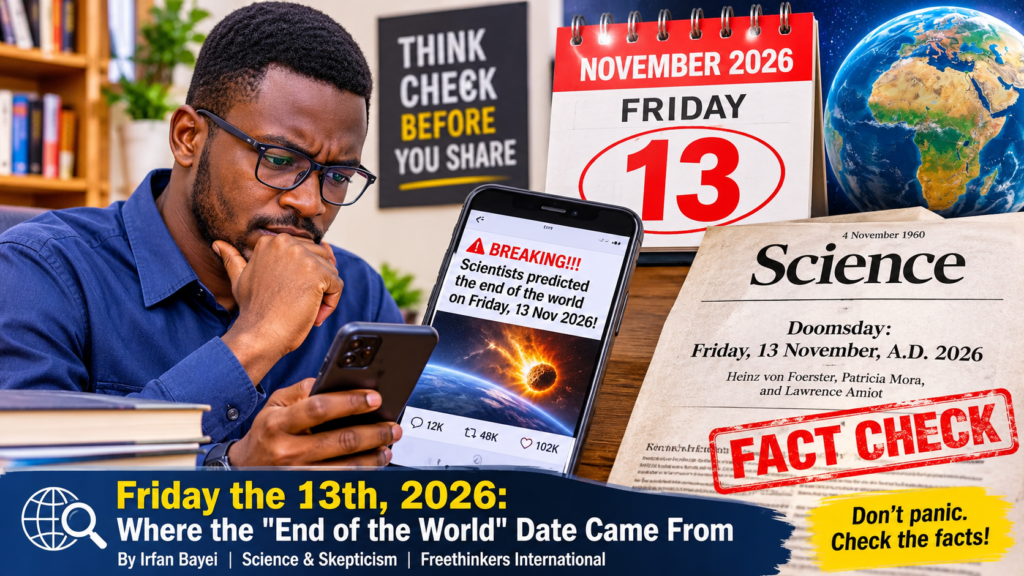
Friday the 13th, 2026: Where the “End of the World” Date Came From
Today is Friday, 13 November 2026.
For weeks, viral posts across social media have claimed that scientists calculated this exact date as the end of the world.
Since you are reading this, the world is still intact. This article traces where the date actually originated, how an academic equation turned into an internet scare, and what history reveals about apocalyptic predictions.
A mathematical warning, not a prophecy
The date comes from a genuine peer-reviewed journal, though not in the way social media screenshots suggest.
On 4 November 1960, the journal Science published a short paper titled “Doomsday: Friday, 13 November, A.D. 2026,” written by physicist Heinz von Foerster alongside Patricia Mora and Lawrence Amiot. Within days, mainstream newspapers reported that scientists had calculated an exact date for the end of humanity.
The paper had nothing to do with asteroids, nuclear war, or supernatural events.
Von Foerster and his colleagues analyzed historical estimates of human population growth over the preceding two millennia and fitted them to a mathematical curve. Their equation showed that if human population growth continued accelerating at its 1960 pace without restraint, the global population would mathematically reach infinity around 2026.87 with a margin of error of plus or minus 5.5 years.
It was a satirical mathematical extrapolation designed to illustrate a basic physical reality: infinite growth is impossible on a finite planet. The choice of date also carried a personal joke. Von Foerster was born on 13 November 1911; he simply selected his own birthday which happened to fall on a Friday the 13th within his margin of error to drive the point home.
How an old equation went viral
Sixty-six years later, screenshots of the 1960 Science title resurfaced online, stripped of its mathematical context.
By early November 2026, viral posts on Threads, X, and TikTok were circulating the paper’s headline as proof that modern science had predicted a November apocalypse. Secondary rumors quickly attached unrelated claims of catastrophic solar flares. In reality, space weather bulletins from the National Oceanic and Atmospheric Administration (NOAA) for 13 November indicated routine geomagnetic conditions with no extreme solar storms.
Recognizing the renewed viral interest, researchers at the Complexity Science Hub in Vienna even convened a public symposium on 12 and 13 November examining the mechanics of doomsday predictions.
Why the 1960 math failed
Von Foerster’s curve failed for a simple reason: human behavior changed.
The 1960 equation assumed that global fertility rates and population acceleration would remain constant forever. Instead, urbanization, access to education, healthcare improvements, and family planning sharply slowed global birth rates over the subsequent six decades.
According to the United Nations’ 2024 World Population Prospects, the global population is projected to peak at roughly 10.3 billion in the mid-2080s before gradually declining. The mathematical infinity of 2026 never arrived because demographic trends are shaped by human choices, not fixed equations.
A familiar pattern of failed dates
Setting specific dates for the end of the world has a long, unbroken record of failure:
1844 (The Great Disappointment): American Baptist preacher William Miller predicted Christ’s return on 22 October 1844. When the day passed uneventfully, thousands of followers were left disillusioned, though remnants later organized the Seventh-day Adventist Church.
1954 (The Seekers): A Chicago group led by Dorothy Martin claimed extraterrestrials would destroy the Earth in a flood on 21 December 1954. When the flood failed to materialize, the group announced their collective faith had spared the planet a psychological reaction famously documented by social psychologist Leon Festinger in When Prophecy Fails.
2011 (Harold Camping): American radio broadcaster Harold Camping predicted Judgment Day for 21 May 2011. After nothing occurred, he revised his calculation to 21 October 2011, which passed just as quietly.
Scholars of apocalyptic movements, including religious historian Catherine Wessinger, note that failed prophets rarely admit error; instead, they reinterpret the date as a “spiritual” event or claim divine mercy postponed the disaster.
When apocalyptic belief turns lethal
Most viral end-times rumors fade into internet humor once the date passes. Others carry devastating real-world consequences.
Just one week ago, on 6 November 2026, a High Court in Mombasa, Kenya, sentenced cult leader Paul Mackenzie to 200 years in prison over the deaths of 191 people 190 of them children who starved to death in the Shakahola forest after he convinced followers to fast to death before the world ended.
The Shakahola tragedy proves that a doomsday claim does not need scientific backing to become lethal. It only needs unchecked authority over vulnerable people and the absence of critical scrutiny.
Three questions to test any viral claim
Before sharing any alarming headline or screenshot, three basic checks separate fact from panic:
1. What is the primary source? Trace the claim back past the social media caption to the original paper, court record, or official agency statement.
2. What does the text actually say? Viral posts routinely turn narrow statistical models or jokes into sensational predictions.
3. What does current evidence show? Check whether real-world data such as UN demographic projections or meteorological forecasts supports the claim.
Friday, 13 November 2026 has arrived as an ordinary day. The real lesson is not that a 1960 equation was wrong, but how easily an old screenshot can still bypass critical thinking in the digital age.