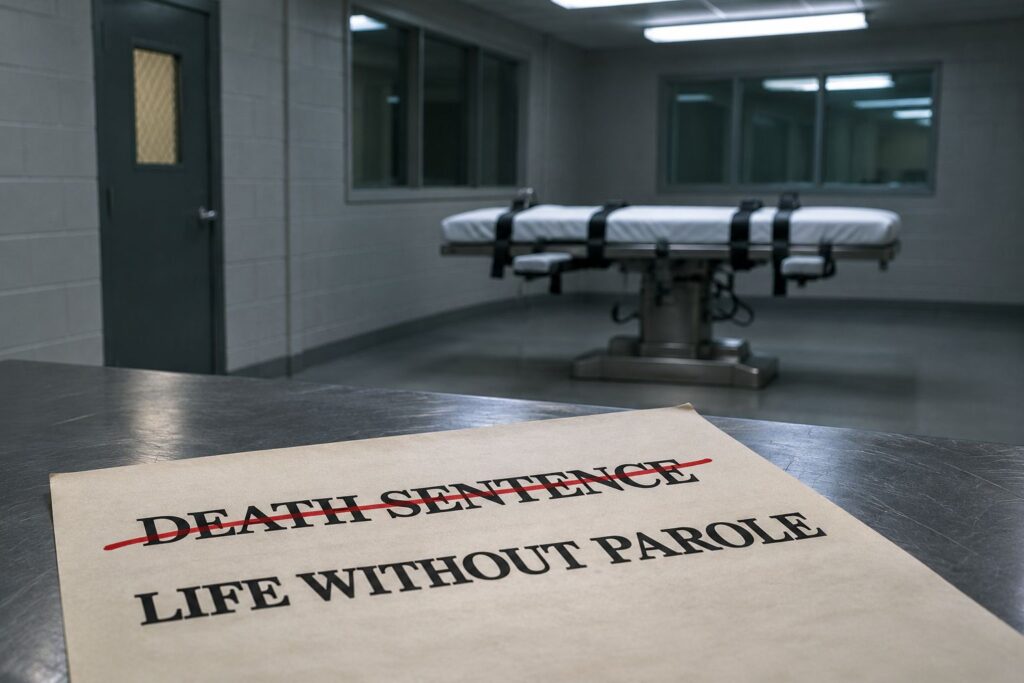
California moves to spare 548 prisoners from execution
California Governor Gavin Newsom has announced plans to replace the death sentences of all 548 people currently condemned in the state with life imprisonment without the possibility of parole.
The November 5 announcement represents a major step against capital punishment. But the distinction between announcing clemency and completing it matters: California’s Habeas Corpus Resource Center says the sentences have not yet been formally commuted. Hundreds require a recommendation from the state Supreme Court before the governor can proceed.
For Freethinkers International, the principle behind the decision deserves support. A government can hold people accountable for terrible crimes without claiming the authority to kill them.
Beyond a temporary pause
Newsom imposed a moratorium on executions in 2019, withdrew California’s lethal-injection protocol, and closed San Quentin’s execution chamber. The state’s last execution took place on January 17, 2006.
A moratorium suspends executions while leaving death sentences in place. Commutation changes the punishment itself. Once completed, the proposed action would replace the existing death sentences with life without parole.
It would not release the prisoners, overturn their convictions, declare them innocent, or erase restitution orders.
That does not make life imprisonment a small punishment. It means the state would continue to impose severe penalties while relinquishing execution in these cases.
The legal process remains unfinished
For prisoners with a separate felony conviction, California’s Constitution requires a recommendation from at least four state Supreme Court justices before the governor may commute their sentences. This applies to approximately 70% of the people covered by the announcement.
Even after the necessary recommendations, Newsom must issue the commutation certificates that give the changes effect. Headlines suggesting that all 548 prisoners have already been removed from death row therefore run ahead of the official position.
Nor would the action abolish capital punishment in California. The death penalty would remain available under state law, and future cases could produce new death sentences. Clearing existing sentences and ending the punishment altogether are separate tasks.
Victims’ families do not speak with one voice
Opponents argue that blanket commutations disregard judgments reached by juries and courts. Crime Victims United has criticized the governor’s decision on those grounds.
Other victims’ relatives support it. The Death Penalty Information Center reports that 50 family members of murder victims signed a letter urging universal clemency. Among the supporters is Jess Nichol, whose sister Polly Klaas was murdered. Nichol has explained that she once supported executing her sister’s killer but no longer sees his execution as necessary for her recovery or public safety.
Their different responses deserve recognition. Grief cannot fairly be presented as a unanimous demand for execution. Supporting survivors requires sustained attention to their needs, whatever their position on punishment.
Accountability without execution
Opposition to the death penalty does not require minimizing murder or pretending every prisoner is innocent. Its strongest principle applies even when guilt is established: human rights place limits on what governments may do to people in their custody.
Execution also makes judicial error irreversible. A system administered by fallible people should not impose a punishment that eliminates every possibility of correction.
Newsom’s announcement is a welcome commitment. Its immediate test is whether the legal process delivers the promised commutations. The larger task remains ending a punishment that gives the state the power to turn a conviction into a deliberate killing.