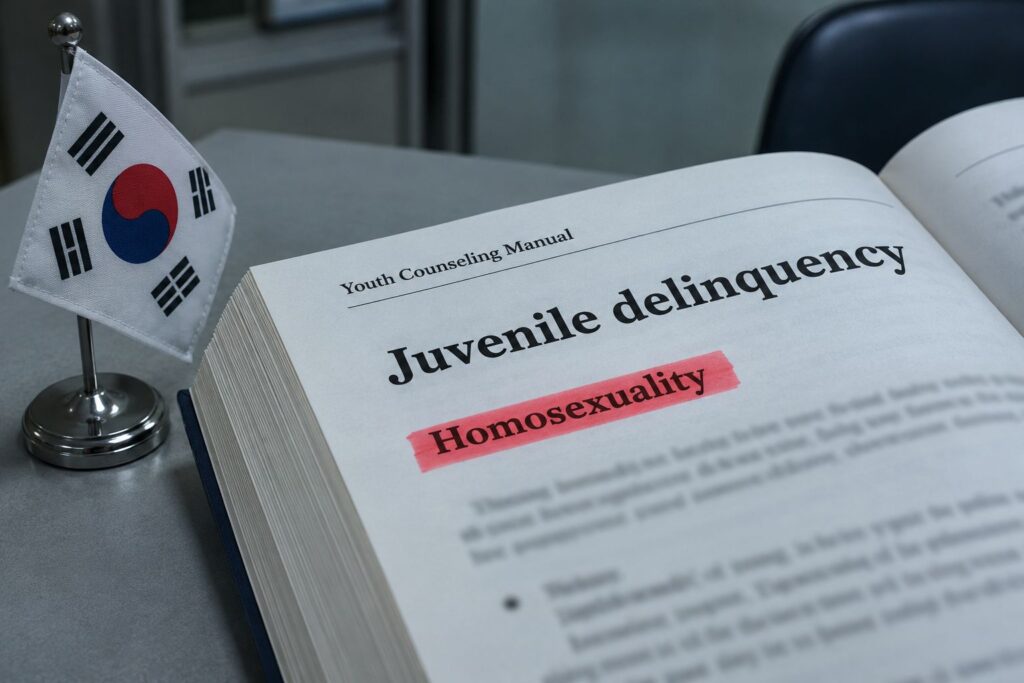
South Korea called homosexuality “juvenile delinquency”
A young person seeking help should not have to wonder whether their counselor considers being gay a form of misconduct. Yet a South Korean youth counseling manual placed homosexuality in a category of delinquency-related issues, alongside sexual violence, theft, and drug-related problems.
The manual was published by the Korea Youth Counseling & Welfare Institute, an organization affiliated with the Ministry of Gender Equality and Family. It guides counselors who work with vulnerable young people and connect them with support services. After Korean media exposed the classification, the government announced that it would correct the passage.
Prejudice in the instructions
According to PinkNews, the classification appeared in editions published in December 2019 and December 2025. The institute attributed it to an editorial error carried over from older reference material. Authorities promised a broader review and stronger human rights training for counselors.
That explanation raises an obvious question: how did such a classification survive revision?
A counseling manual helps establish what professionals recognize as a problem and how they respond to it. Placing homosexuality alongside harmful or criminal behavior risks giving institutional authority to prejudice. For someone already afraid of rejection, encountering that attitude in a support service could make seeking help even harder.
The reporting does not establish how individual counselors used the passage or how many young people were affected. Nevertheless, its presence in official guidance deserves scrutiny beyond deleting the offending words.
An apology—and a test of implementation
The ministry expressed regret and said it would consult experts on further revisions. It also pointed to changes made in August to a separate manual for youth shelters, explicitly prohibiting discrimination based on sexual orientation or gender identity.
Those shelter guidelines required staff to record their reasons for refusing admission or asking residents to leave, helping establish whether decisions were discriminatory.
These are meaningful safeguards. Their value, however, depends on whether staff understand and follow them—and whether young people can challenge mistreatment without jeopardizing their access to support.
The contrast between the two manuals also exposes a failure of consistency. One part of the system was instructing shelters to prevent discrimination while another still categorized homosexuality as delinquency.
Being gay is not a safeguarding problem
The government’s willingness to acknowledge the problem and promise corrections is welcome. Accountability should now include checking related materials, explaining how the passage survived, and involving LGBTQ+ people in reviewing the services intended to help them.
Counselors should address abuse, distress, isolation, and discrimination. They should help young people understand themselves without shame.
A young person’s sexual orientation does not belong on a list of wrongdoing. Prejudice within a public support service does.