Two Judges, One Party, One Question: Who Decides Who Can Stand for President?
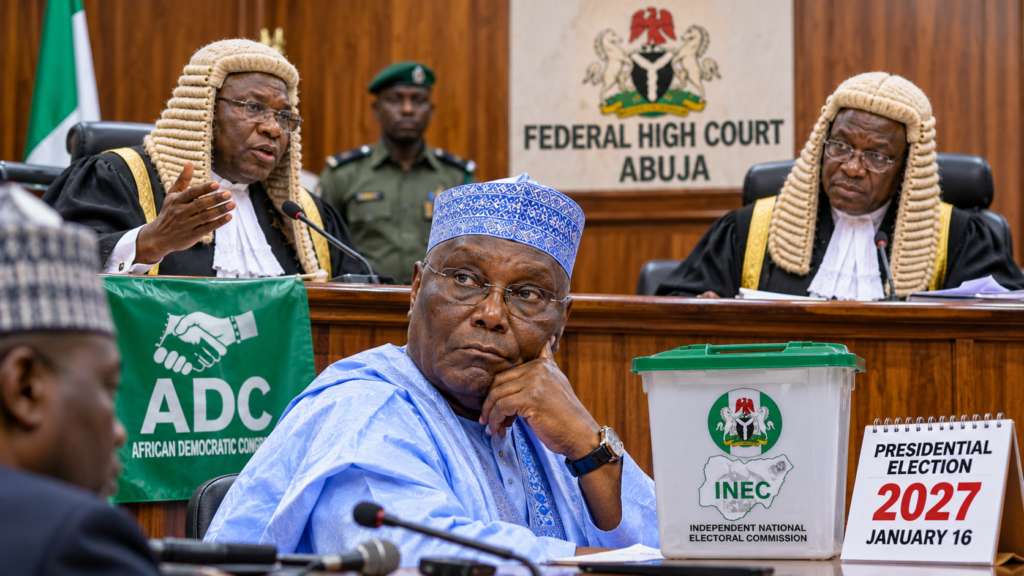
On Thursday, 5 November 2026, the Federal High Court in Abuja invalidated the presidential ticket of Atiku Abubakar.
With the presidential election scheduled for 16 January 2027, the ruling lands just ten weeks before polling day.
Delivering judgment, Justice Peter Lifu declared the Senator David Mark-led caretaker committee of the African Democratic Congress (ADC) unconstitutional and void. The court consequently nullified all actions undertaken by that leadership, including the 25 May primary election that nominated Mr Abubakar as the party’s presidential flagbearer.
The ADC immediately announced an appeal, with Mr Abubakar asserting that “the timing of this judgment is no coincidence”. Beyond partisan claims, the public record discloses a deeper institutional problem: how two judges of coordinate jurisdiction within the same court issued directly contradictory decisions on the same political leadership within four months.
What the court decided
The suit was instituted by Nafiu Bala Gombe, a former National Deputy Chairman (North-East) of the ADC.
Gombe argued that following the resignation of former National Chairman Chief Ralph Nwosu, party statutes entitled him to assume interim leadership. He contended that the coalition takeover orchestrated by Senator David Mark as National Chairman and Ogbeni Rauf Aregbesola as National Secretary violated both the ADC constitution and statutory nomination frameworks.
Justice Lifu agreed with the plaintiff, barring Mr Mark and Mr Aregbesola from parading themselves as national officers and invalidating the nominations submitted under their tenure.
The judgment addressed institutional legitimacy and statutory compliance. It was a determination of internal procedure, not a verdict on candidate popularity or character.
The conflicting docket
This leadership dispute has wound through the judicial system throughout 2026.
Following an earlier Court of Appeal order, the Independent National Electoral Commission (INEC) had removed the Mark-led executive from its official portal. On 30 April 2026, the Supreme Court set aside that appellate directive as premature and remitted the substantive dispute back to the Federal High Court for trial on its merits. Following that apex order, INEC restored the Mark-led leadership to its registry.
The jurisdictional friction intensified on 2 July 2026.
In suit FHC/ABJ/CS/1637/2025, filed by House of Representatives member Leke Abejide, Justice Musa Liman upheld the Mark-led leadership, dismissing the challenge on the grounds that internal party leadership falls within party autonomy and constitutes a non-justiciable domestic affair.
On 5 November, in suit FHC/ABJ/CS/1819/2025, Justice Lifu reached the opposite conclusion on the very same caretaker leadership.
Two federal judges sitting on the same bench delivered incompatible orders on whether the executive committee managing a registered political party exists in law.
Allegations versus evidence
Following the verdict, the ADC leadership described the decision as legally unsustainable, alleging external political interference by the ruling All Progressives Congress (APC). Mr Abubakar’s campaign characterized the judgment as a coordinated maneuver designed to destabilize the primary opposition challenge weeks before ballots are cast.
The legal distinction between a political accusation and verified evidence must be stated clearly.
No empirical documentation, sworn affidavit, or formal petition has been submitted to the National Judicial Council (NJC) establishing that the executive branch or the ruling party influenced the bench. Until substantiated by documentary evidence or regulatory findings, allegations of executive direction remain partisan assertions.
The structural cost of uncertainty
The immediate crisis does not depend on proving political motives. It rests on judicial unpredictability.
Under Section 285(10) of the 1999 Constitution (as amended), pre-election appeals must be disposed of within accelerated statutory timeframes. However, ten weeks before an election, conflicting high court judgments impose three direct systemic costs:
Voter Bewilderment: When federal courts deliver conflicting declarations on party legitimacy, voters cannot ascertain whether published candidates remain lawful contenders.
Administrative Paralysis: INEC, having already published the final list of presidential candidates, faces competing judicial declarations regarding its own official register.
Institutional Erosion: Conflicting judgments among judges of equal rank weaken public trust in the consistency of legal adjudication.
Questions the record can answer
Democratic accountability requires citizens to evaluate electoral litigation on facts rather than rhetoric:
Cause of Action: What specific statutory questions distinguished Justice Liman’s July decision on party autonomy from Justice Lifu’s November decision on constitutional breach?
Appellate Expedition: Has the Court of Appeal constituted an emergency panel to resolve the coordinate conflict within the statutory window before 16 January?
Status Quo: What administrative protocol will INEC adopt regarding certified candidate lists while the appellate review is pending?
The rule of law does not demand that citizens avoid hard questions about judicial outcomes. It demands that opinions rest on evidence, transparent records, and settled legal principle rather than campaign press releases.