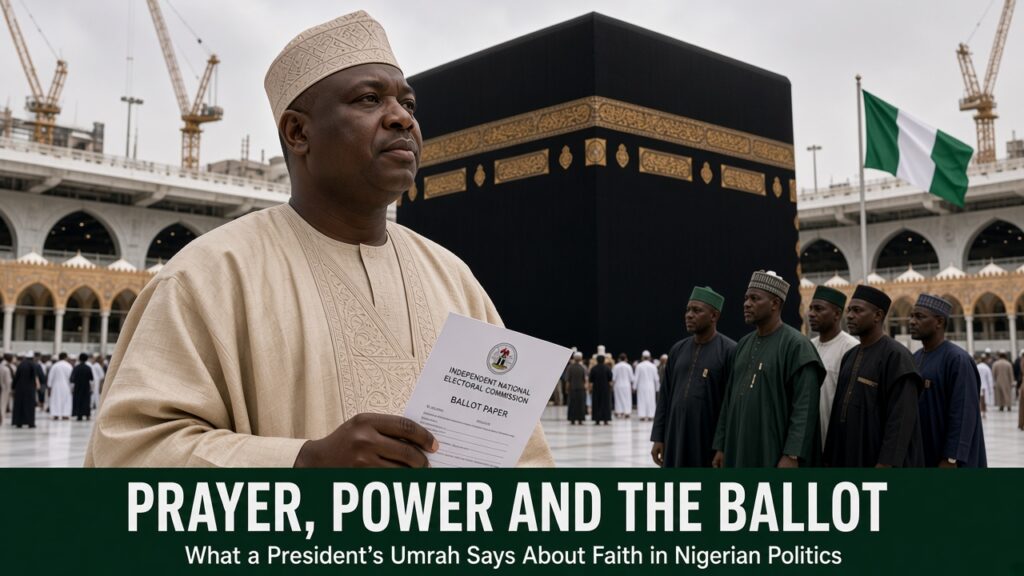
Prayer, Power and the Ballot: What a President’s Umrah Says About Faith in Nigerian Politics
On Monday, 2 November 2026, President Bola Tinubu entered the Kaaba in Makkah.
He had arrived in Saudi Arabia for a five-day state visit, performed Umrah, and kissed the Black Stone before being granted entry alongside the Nigerian delegation.
Coming precisely eleven weeks before the 16 January 2027 general election, a presidential pilgrimage naturally carries domestic political weight. This article examines the public record of the visit, the economic claims made during it, and the constitutional balance between personal faith and public accountability.
The delegation and the ritual
According to statements from the State House, Saudi authorities granted the Nigerian delegation rare access inside the Kaaba, led by Grand Mosque official Sheikh Dahlulah Muthawal.
The delegation included key executive officials: the Attorney-General of the Federation, Lateef Fagbemi, and the Coordinating Minister of Health, Prof. Muhammad Ali Pate. It also featured state governors from Borno, Sokoto, Jigawa, Kaduna, Yobe, and Kwara, along with prominent corporate executives, including the chairman of BUA Group and the chief executive of Oando.
The Black Stone, set into the eastern corner of the Kaaba, marks the starting point for the ritual tawaf. Emulating the Prophet Muhammad by kissing or touching the stone is a long-standing sunnah observed by millions of Muslims annually. As a matter of constitutional law and civil liberty, an elected official’s right to engage in devotional rites is absolute.
Two distinct claims
In an official briefing issued by presidential spokesman Bayo Onanuga, Mr Tinubu stated that he prayed for the wisdom and resilience to continue serving the federation, expressing confidence that the prayer had been answered. He also referenced his pre-2023 electoral pilgrimage, framing the current journey as an act of thanksgiving.
However, the official communication moved beyond personal thanksgiving into macroeconomic assessment. Several national outlets cited the president’s direct assertion: “The foundation is solid, and the economy has come out of the dark tunnel.”
A critical reader must separate these two elements:
The devotional right: Under Section 38 of the 1999 Constitution, freedom of thought, conscience, and religion protects every citizen, including the president. Simultaneously, Section 10 prohibits the state from adopting a state religion. Personal devotion remains a protected civil right.
The policy claim: An economic assertion does not become immune to empirical scrutiny simply because it was delivered from a holy site. Whether an economy has “exited the dark tunnel” is a matter of measurable public data.
Examining the indicators
What does the statistical baseline show regarding the claim of an economic turnaround?
On one hand, supporters point to statistical moderation. National Bureau of Statistics (NBS) data shows headline inflation decelerated to 15.39 percent in August 2026, down from 15.43 percent in July, with food inflation easing to 19.57 percent. World Bank projections released in October 2026 also estimate that national poverty could decline from 63 percent toward 59 percent by 2028, provided food prices continue to moderate.
On the other hand, critics point to absolute price levels on the ground:
Fuel Costs: Official NBS records show average retail petrol prices stood at ₦1,048.63 in December 2025. By October 2026, NNPC outlets retailed at ₦1,355 in Lagos and ₦1,370 in Abuja, with pump prices exceeding ₦1,500 in northern retail stations.
Purchasing Power: At prevailing exchange rates, the national minimum wage of ₦70,000 equals approximately $52, leaving low-income households struggling to absorb high transport and basic food outlays.
Slowing inflation means prices are climbing at a less rapid rate; it does not mean essential goods have become cheaper. Whether these metrics substantiate an exit from the economic tunnel remains an individual calculation for each voter.
Faith and the 2027 ballot
Public displays of piety by political leaders are deeply rooted in Nigerian electoral history across both Christian and Muslim leadership.
Critics often dismiss such appearances as tactical political theater designed to consolidate conservative voting blocs ahead of contested elections. Supporters maintain that a public figure’s sincere personal faith should not be reduced to campaign cynicism.
For the democratic electorate, the constitutional distinction remains straightforward:
Was public revenue used to sponsor the non-statutory travel of members of the delegation, and is that expenditure itemized on public procurement portals?
Does the assertion of economic recovery align with household purchasing power in one’s local ward?
When official discourse emphasizes spiritual reassurance, does it accompany transparent policy blueprints?
Devotion is a private right protected by the constitution. The expenditure of public funds and the verification of economic claims remain the legitimate business of every citizen.