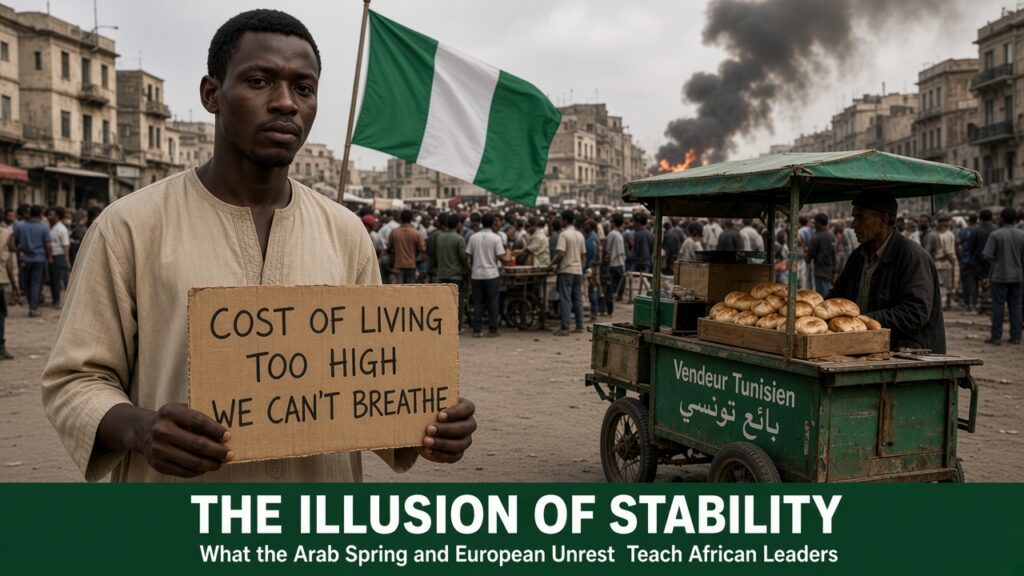
The Illusion of Stability: What the Arab Spring and European Protests Teach African Leaders
Governments often believe that control over the police, the army, and the courts means a country is stable. History shows that this assumption is dangerous. A government can look fully in charge on Monday and lose control by Friday if it ignores public suffering.
From the 2011 Arab Spring to modern street protests across Europe, one lesson stands out: when basic public anger builds up for years without an answer, security forces alone cannot stop what follows. For leaders across Africa, and Nigeria in particular, the warning is clear.
When a vendor’s death unseated rulers
In December 2010, Mohamed Bouazizi, a young vegetable seller in Tunisia, set himself on fire after police officers seized his cart and publicly humiliated him.
That single act sparked protests that swept across North Africa. Within weeks, President Zine El Abidine Ben Ali fled Tunisia after twenty-three years in power. In Egypt, Hosni Mubarak was forced out in eighteen days after nearly thirty years in office. In Libya, Muammar Gaddafi’s forty-two-year rule ended in a ruinous civil war. In Syria, demonstrations turned into an armed conflict that broke the country, killed hundreds of thousands, and forced millions from their homes.
None of these rulers lacked weapons or armed men. They ran large secret police units and spent heavily on surveillance. Yet when millions of people decided they had nothing left to lose, those security networks could not save them. Coercive force can intimidate people for years, but it cannot solve hunger, joblessness, and humiliation.
Wealthy nations also face the street
This is not a problem for poor or military-ruled countries alone.
In Europe, nations with strong economies and established courts still face fierce civil unrest when citizens feel government policies are unfair.
In 2023, after French police fatally shot a teenager named Nahel Merzouk, protests erupted across France. Within days, demonstrators burned more than 12,000 cars and damaged roughly 2,500 buildings, including town halls and police stations. Retailers and insurers counted losses of more than €1 billion.
France is one of the richest countries in the world. It has strong courts and well-equipped riot police. Yet its streets still caught fire because the gap between what citizens expected and what the government delivered grew too wide.
The Nigerian danger: silence is not agreement
The economic pain that fueled these protests is familiar to anyone living in Nigeria today.
Food prices have doubled. The minimum wage buys fewer basic goods each month. Young graduates struggle to find decent work.
In Nigeria, political leaders often make the mistake of treating public silence as acceptance. In reality, ordinary people are simply enduring, waiting to see if promises will turn into relief. But patience has a limit. When a government removes economic supports without providing real safety nets, it pushes that limit.
Section 40 of the 1999 Constitution guarantees the right to assemble peacefully. When the state treats peaceful economic protests as crimes, deploying tear gas and arrests rather than addressing living costs, it does not solve the problem. It only delays the reaction.
A hard truth from the Arab uprisings
There is also an important lesson for citizens: changing a government does not automatically make life better.
In Tunisia, Egypt, Libya, and Syria, removing a dictator did not immediately bring good jobs, honest courts, or lasting safety. In Libya and Syria, the fall of central authority allowed armed militias and criminal networks to take over, leaving ordinary families in worse conditions than before.
Pulling down an old government takes days. Building honest courts, functional hospitals, reliable schools, and professional police takes decades. Change that destroys public infrastructure without a plan to govern only brings fresh misery.
What good governance actually looks like
The lesson from Tunisia, Cairo, and Paris is simple: force cannot replace trust.
A government that depends on armed checkpoints to maintain order is not strong; it is merely reacting to crises. Real governance requires three things anyone can verify:
- Listening before protests begin: Answering public complaints through policy before anger spills into the streets.
- Fair economic burden: Not asking the poorest citizens to bear the full cost of national financial repairs while politicians live in luxury.
- Equal rules: Holding public officials to the same laws they enforce on everyone else.
Power is a temporary trust, not a permanent property. Leaders who ignore the cost of living today are not showing strength. They are simply building the crisis of tomorrow.