200 Years: What the Shakahola Verdict Says About Faith, Harm and the Law
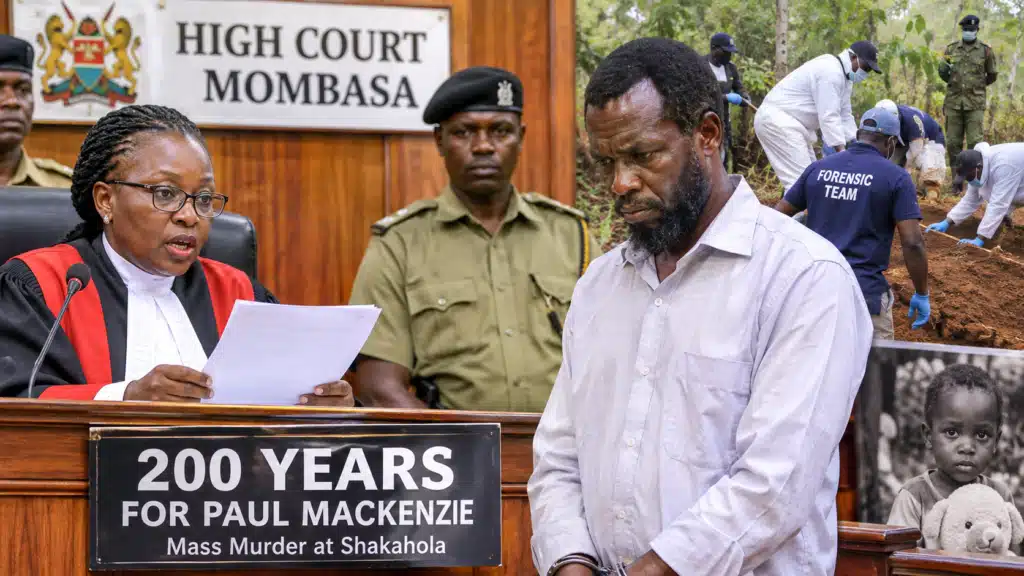
On Friday, 6 November 2026, a High Court in Mombasa, Kenya, sentenced cult leader Paul Mackenzie to 200 years in prison.
Delivering the verdict, Justice Diana Kavedza found Mackenzie criminally responsible for the deaths of 191 victims 190 of them children who perished from forced starvation inside the Shakahola forest. The court characterized the deaths as an act of mass murder and held Mackenzie primarily accountable.
The ruling carries legal and social implications far beyond Kenya’s borders. It demonstrates what unfolds when unchecked religious authority operates outside state oversight, and where secular courts must draw the line when faith causes lethal harm.
Inside the Shakahola enclave
Mackenzie, a former taxi driver who founded the Good News International Church, constructed an apocalyptic movement around imminent end-times prophecy. According to investigative reports and witness testimonies, he instructed followers to fast to death—and force their children to do the same—so they could ascend to heaven before the world ended.
Former followers testified that Mackenzie prohibited members from enrolling children in formal schools or seeking medical treatment at hospitals, branding public healthcare and education as satanic institutions.
Followers relocated to secluded, unmonitored settlements spanning an 800-acre expanse of the Shakahola forest near the coastal town of Malindi. Law enforcement began exhuming shallow mass graves in April 2023.
The scale of the toll
While this specific indictment focused on 191 deceased victims, forensic teams and the Kenya National Commission on Human Rights (KNCHR) ultimately recovered 448 bodies from the forest compound.
The Mombasa court also convicted 28 co-accused accomplices for their roles in enforcing the starvation regime, handing down custodial sentences ranging between 100 and 160 years. For Mackenzie, Justice Kavedza imposed two consecutive 100-year sentences one for murder by starvation and another for direct homicide totaling 200 years without realistic prospect of release.
Missed warnings and regulatory blind spots
The Shakahola tragedy did not occur without prior state contact.
Kenyan security agencies had placed Mackenzie under scrutiny as early as 2017 following raids on his premises over radicalization and child deprivation claims. In December 2023, prior to the murder trial, he was convicted and sentenced to 12 months for producing and distributing unlicensed extremist films.
Kenyan oversight bodies now face pointed questions regarding how an individual under active state surveillance successfully moved hundreds of families into an isolated forest enclave without triggering child-welfare intervention.
This institutional failure mirrors patterns documented across Northern Nigeria: warning signs rarely remain hidden, yet regulatory agencies frequently hesitate to intervene when harmful practices are framed as religious expression.
The Nigerian parallel
Though set in coastal Kenya, the Shakahola verdict speaks directly to vulnerabilities within Nigerian society.
In previous investigative reports—examining unregulated spiritual rehabilitation centers where patients are held in chains, predatory faith-based financial schemes, and children violently ostracized over witchcraft accusations—the underlying mechanism remains identical: unchecked spiritual authority operating over vulnerable dependents without institutional accountability.
In Kenya, the court’s ruling has sparked an urgent policy debate on the state regulation of religious organizations. Alongside the custodial terms, Justice Kavedza recommended formal deradicalization programs for the convicts and mandated sustained psychological support for child survivors.
Where belief ends and the law begins
In constitutional democracies, the boundary between religious liberty and criminal accountability is clear.
Under Section 38 of the 1999 Constitution of Nigeria, every citizen enjoys freedom of thought, conscience, and religion, including the right to manifest and propagate belief. However, Section 45 explicitly qualifies that right, empowering the state to enforce laws reasonably justifiable in a democratic society in the interest of public safety, public order, and the protection of the rights and freedoms of other persons.
The Mombasa judgment applies this exact legal distinction in practice:
A citizen is legally free to believe the world is ending.
A preacher is legally free to proclaim apocalyptic theology.
No person is legally permitted to deprive children of food, medical care, or life in pursuit of a doctrine.
Enforcing criminal law against lethal religious coercion is not an attack on faith. It is the baseline duty of a state to protect human life—particularly the lives of children who cannot consent to their own destruction.
Questions the record can answer
Preventing similar tragedies requires institutional vigilance rather than reactive mourning:
Regulatory Oversight: Which Kenyan agencies documented Mackenzie’s activities between 2017 and 2023, and what statutory gaps prevented decisive child-protection intervention?
Child Welfare Enforcement: How effectively do Nigerian ministries of education and social welfare monitor religious communes or residential centers that deny children access to schools and primary healthcare?
Preventive Accountability: If an isolated sect began restricting children’s access to food and medicine within a Nigerian local government area today, which agency bears statutory responsibility to intervene immediately?
Mackenzie will spend the remainder of his life in prison. For the judiciary, that constitutes accountability. For bereaved parents, no prison term can restore a lost child.
The enduring challenge for both Kenya and Nigeria is building public institutions alert enough to intervene before isolated compounds turn into mass graves.