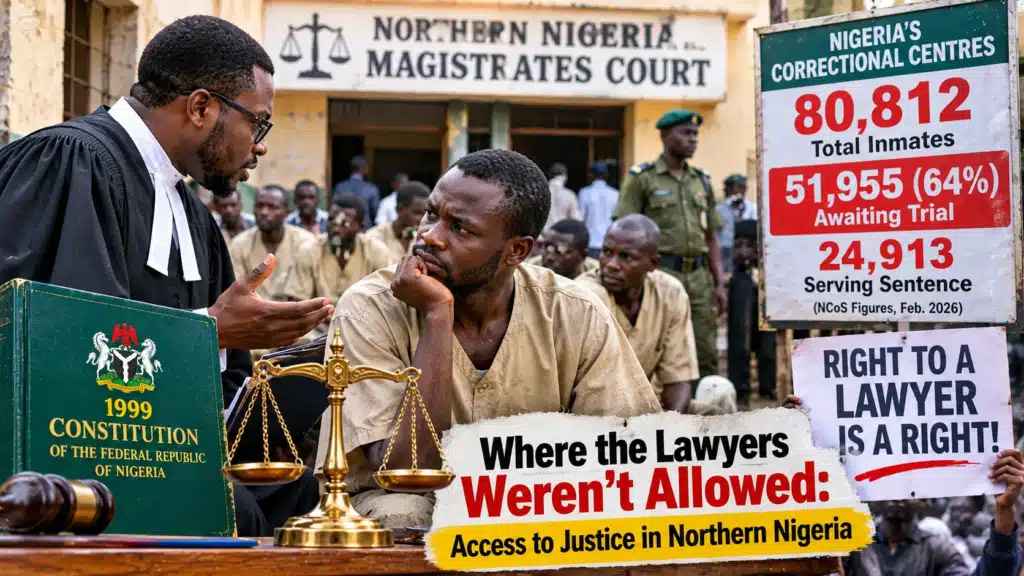
Where the Lawyers Weren’t Allowed: Access to Justice in Northern Nigeria
Nigeria is holding 80,812 people in its correctional centres.
According to official figures from the Nigerian Correctional Service (NCoS) released in February 2026, 51,955 of those inmates, roughly 64 percent, have not been tried or convicted. Only 24,913 are serving actual sentences.
In legal terms, nearly two out of every three people locked behind bars in Nigeria remain presumed innocent.
This article examines a foundational question of justice: what does it take for an ordinary citizen in Northern Nigeria to secure legal representation, and what happens when the system leaves them to face the state alone?
The scale of pretrial detention
Correctional Service records illustrate a steadily widening bottleneck.
In December 2025, 50,703 awaiting-trial inmates were in custody. Within two months, by February 2026, that population had grown by 1,252.
In July 2026, the Minister of Interior, Olubunmi Tunji-Ojo, noted that 93 percent of inmates in federal custodial facilities are being held for offences under state laws, rather than federal statutes. While the Federal Government funds and manages the prisons, the backlog begins largely in state magistrates’ and area courts.
On 15 May 2026, the ECOWAS Community Court of Justice ruled that prolonged pretrial detention and severe prison overcrowding in Nigeria violate fundamental rights to personal liberty, human dignity, fair hearing, and trial within a reasonable time.
Despite these pressures, alternative punishments remain rare. Only 1,271 offenders across the country were serving non-custodial sentences as of July 2026, prompting the Service to propose ₦37.99 billion in its 2026 budget framework to expand community-based sentencing.
A statutory ban that lingered on paper
The absence of lawyers in lower northern courts is rooted in colonial legal design.
When the British administration structured Northern Nigeria’s judicial hierarchy, Native Courts, later reconstituted as Area Courts, were intended to settle local disputes informally under customary and Islamic law without professional advocates. Judges were typically local scholars or administrators rather than common-law practitioners.
Statutory rules formally excluded lawyers from these benches. Section 28 of the Area Courts Edict of 1967 barred legal practitioners from appearing for or assisting any party before an Area Court. Section 390 of the Criminal Procedure Code imposed an identical restriction.
Nigerian superior courts eventually dismantled those barriers on constitutional grounds. In 1982, in Uzodinma v. Commissioner of Police, the High Court invalidated Section 390 of the Criminal Procedure Code, affirming that defendants hold a constitutional right to legal counsel in all courts, including Area Courts. In 1985, the Court of Appeal in Karimatu Yakubu v. Yakubu Paiko extended that right of audience to civil proceedings.
As legal scholar Abdulmumini Oba has observed, several state legislatures never formally repealed those restrictive clauses from their statute books. Under Section 1(3) of the 1999 Constitution, any law inconsistent with the Constitution is void, which allows lawyers to appear freely in Area Courts today. Yet the unamended text remains a relic of a system built to keep advocates out.
What the Constitution guarantees
On paper, Nigerian constitutional protections are unambiguous:
* Section 35 guarantees personal liberty and requires that anyone arrested or detained be brought before a court within a reasonable time.
* Section 36(5) establishes that every person charged with a criminal offence is presumed innocent until proved guilty.
* Section 36(6)(c) guarantees every defendant the right to defend themselves in person or by a legal practitioner of their own choice.
When twelve northern states enacted Sharia Penal and Criminal Procedure Codes after 1999, they retained this guarantee. Zamfara State’s Shari’ah Criminal Procedure Code, for instance, explicitly affirms the right of legal practitioners to appear and represent litigants in Sharia courts.
The legal right to counsel is settled. The practical barrier is whether indigent defendants know that right exists and can access a lawyer.
When defendants are never told
A constitutional right has little value if an accused person does not know they possess it.
In a 2004 investigation into Sharia court trials in Northern Nigeria, Human Rights Watch documented how the lack of legal representation shaped capital cases. During her initial trial in Katsina State, Amina Lawal was sentenced to death by stoning without a lawyer present; she was never informed of her right to counsel or the legal consequences of a confession.
Researchers found that many rural litigants across the region were unaware they could hire a lawyer, and some had been led to believe that Islamic courts prohibited legal representation altogether.
Similar concerns have surfaced in more recent high-profile cases. In the appeal of musician Yahaya Sharif-Aminu, defence lawyers argued before appellate courts that he was tried and sentenced to death by an Upper Sharia Court in 2020 without legal representation, a central issue reflected in the appellate record.
The limits of legal aid
To bridge the gap for citizens who cannot afford private fees, the Federal Government established the Legal Aid Council of Nigeria, now governed by the Legal Aid Act of 2011. The statute mandates free legal representation in criminal matters and select civil claims for indigent citizens.
However, legal analysts and bar assessments consistently highlight severe operational constraints: chronic underfunding, a shortage of salaried state counsel, bureaucratic delays, and low public awareness outside state capitals. Without transparent, publicly accessible state-by-state caseload audits, measuring how many rural detainees actually receive timely representation remains difficult.
Proposals on the table
Judicial reformers and commentators have pointed to practical remedies already permitted under Nigerian law:
* Special Custodial Courts: Legal editorials have urged Chief Judges to deploy designated magistrates and judges to sit regularly inside correctional centres to review prolonged detentions, hear bail applications, and strike out stalled cases.
* Non-Custodial Sentencing: Expanding community service, probation, and fines under the Nigerian Correctional Service Act of 2019 can divert minor offenders away from overcrowded cells before trial delays turn months into years.
Both measures require sustained state funding and active coordination between state ministries of justice, the police, and the judiciary.
Questions the record can answer
Closing the gap between constitutional text and courtroom reality requires clear answers from state institutions:
* Detention Audits: What is the average duration of pretrial detention across northern state prisons, and how many inmates have been held longer than the maximum sentence for their alleged offences?
* Legal Aid Capacity: How many full-time Legal Aid Council lawyers are currently deployed to rural judicial divisions outside state capitals, and how many trials did they complete over the past year?
* Statutory Cleanup: Which northern state assemblies have formally repealed obsolete clauses barring legal practitioners from Area Courts?
* Judicial Duty: What administrative guidelines require lower court judges to inform unrepresented defendants on the record of their right to counsel before taking a plea?
The right to a lawyer was written into Section 36 of the Constitution so that an ordinary citizen without wealth or political influence would never have to stand alone against the power of the state.
A right that goes unexplained in court, and unaffordable in practice, leaves the poorest citizens behind bars while their cases gather dust.