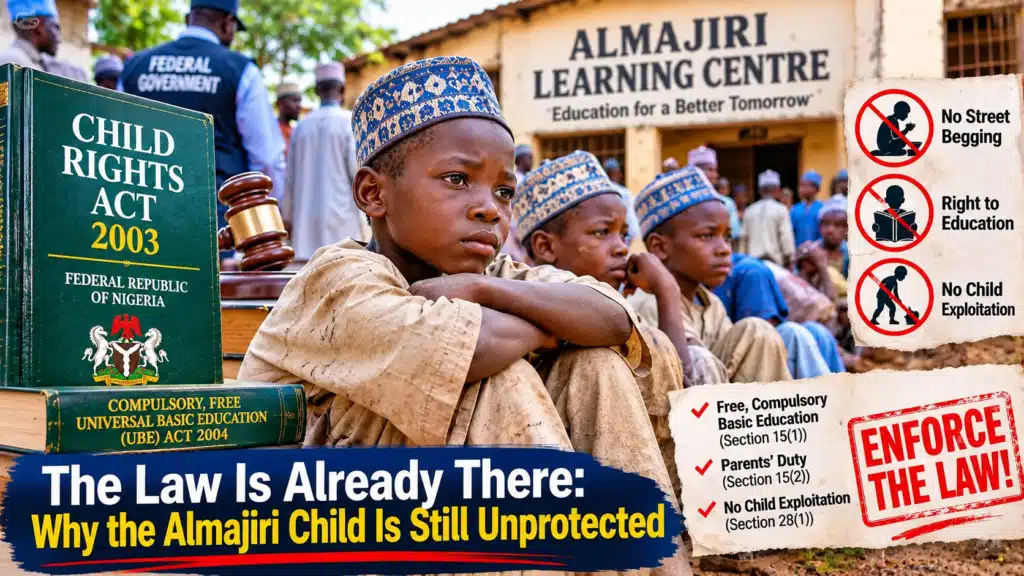
The Law Is Already There: Why the Almajiri Child Is Still Unprotected
In August 2026, four young boys died in Kano after eating discarded fish they found while running errands.
In June 2025, two other Almajiri pupils died in Kano after drinking a toxic chemical substance they mistook for milk.
In August 2026, the Federal Government unveiled a new national policy banning street begging across Almajiri learning centers.
All of these events occurred in a country that already possesses clear statutory protections against child neglect and exploitation. The pressing legal question is not whether protective statutes exist, but why they fail to reach the children who need them most.
What federal statutes guarantee
The Child Rights Act of 2003 sets the foundational legal standard for child welfare in Nigeria. Three of its provisions apply directly to the street-begging system:
* Section 15(1): Establishes that every child has the right to free, compulsory, and universal basic education, placing an explicit statutory duty on the government to provide it.
* Section 15(2): Mandates every parent or guardian to ensure that a child attends and completes both primary and junior secondary education.
* Section 28(1): Prohibits subjecting any child to forced or exploitative labor, or using a child for any purpose that deprives them of the opportunity to attend school.
The Compulsory, Free Universal Basic Education (UBE) Act of 2004 reinforces these obligations. While educational goals in Chapter II of the 1999 Constitution are non-justiciable policy directives, Nigerian courts and the ECOWAS Community Court of Justice notably in the landmark SERAP litigation have affirmed that basic education rights codified under the UBE Act and the African Charter are legally enforceable.
An outdated penalty
Section 15(6) of the 2003 Act prescribes the penalty for a parent who fails to send a child to school.
For a first offence, the statute stipulates a reprimand or a maximum fine of ₦5,000. For a subsequent conviction, the court may impose a fine of up to ₦10,000 or imprisonment for a term not exceeding one month.
At current retail pump prices of roughly ₦1,400 per liter, a ₦5,000 fine equals the cost of three and a half liters of petrol. A statutory deterrent designed over two decades ago carries negligible financial weight today.
Domesticating the law in the North
For years, child advocacy debates focused on the refusal of northern state legislatures to adopt the federal Child Rights Act. That legislative barrier has largely fallen.
Between 2022 and 2024, holdout northern states including Borno, Adamawa, Kano, Jigawa, and Bauchi enacted state-level Child Protection Laws, bringing all 36 states and the Federal Capital Territory under statutory child-protection frameworks.
However, domestication has introduced two fresh legal challenges:
* Inconsistent Standards: State enactments are not uniform. Several northern versions modified key definitions regarding the minimum age of marriage and the scope of domestic guardianship, creating uneven legal protections across state lines.
* Dormant Enforcement: Passing a bill into law does not automatically build social welfare inspectorates, juvenile courts, or enforcement budgets.
The central challenge is no longer legislative adoption; it is executive enforcement.
A policy is not a statute
The August 2026 national policy prohibiting street begging requires Almajiri centers to register with authorities, capture pupils’ biometric records, and maintain minimum sanitation and welfare standards, warning non-compliant centers of closure.
In administrative law, however, a national policy document is an executive guideline, not an Act of the National Assembly. A policy paper cannot create new criminal offences or confer arrest powers on its own.
Furthermore, under Nigeria’s federal structure, basic education and local religious schools fall under state and local government jurisdiction. The Federal Ministry of Education cannot unilaterally walk into a community in Katsina or Bauchi and shut down an informal Qur’anic school; state authorities must invoke specific state statutes to regulate or close non-compliant facilities.
Three layers of unfulfilled duty
Under existing Nigerian child protection laws, three distinct actors hold enforceable responsibilities:
* Guardians and Instructors: Any guardian or instructor who sends a child onto the streets to beg or perform hazardous chores in exchange for daily meals breaches the statutory prohibition against child exploitation under Section 28. Yet public prosecutions for Almajiri street begging remain virtually nonexistent.
* Parents: Parents who surrender parental custody without ensuring basic education or material welfare violate Section 15(2).
* The State: After 2012, the Federal Government constructed over 150 integrated Almajiri model schools across northern states to combine religious instruction with basic literacy. Many of those facilities were later abandoned or underutilized due to poor state handover protocols and maintenance failures. A government that allows public schools to decay fails its primary duty under Section 15(1).
Questions the record can answer
Moving from policy announcements to measurable child protection requires public answers to four direct questions:
* Prosecutorial Record: How many individuals have been charged or convicted under state Child Protection Laws for subjecting Almajiri minors to street begging or hazardous labor?
* Regulatory Compliance: Since August 2026, how many traditional learning centers have been formally registered and inspected by state ministries of education and social welfare?
* Statutory Authority: Which specific sections of state law are state governments relying on to enforce closures against centers that violate child welfare standards?
* Infrastructure Audit: What is the current operational status of the integrated Almajiri model schools built after 2012?
A statute that remains confined to law libraries protects no child on the street. Until state governments pair existing child protection laws with active welfare enforcement and functional public schools, vulnerable children will continue to pay the ultimate price.