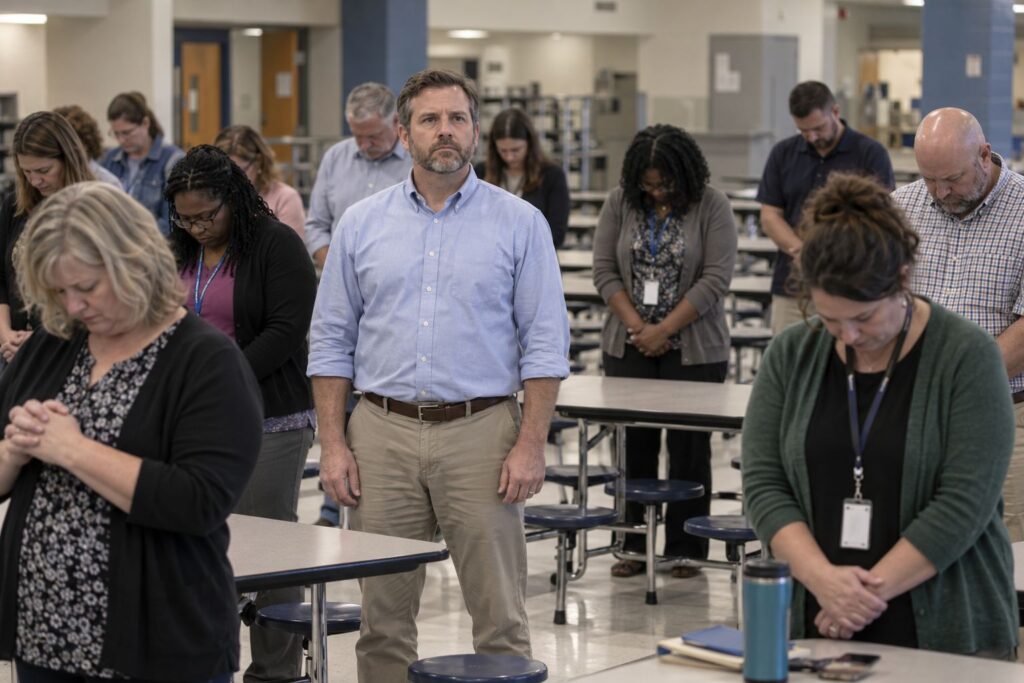
A teacher says he was forced to pray. Now he is suing
Juan Antonio Castillo went to work to teach Spanish. According to his lawsuit, working for a Texas public school district also meant being instructed to stand, bow his head and participate in Christian prayers.
On October 28, the former Rio Hondo Middle School teacher filed a federal lawsuit challenging religious practices at mandatory staff meetings. Castillo, a humanist with 25 years of experience in education, alleges that district officials repeatedly pressured him to participate in religious observances contrary to his beliefs.
His case raises a basic question: how free is a religious exercise when the person leading it has authority over your employment?
When the boss tells everyone to pray
According to the American Humanist Association, which represents Castillo, mandatory meetings included evangelical Christian prayers led by the superintendent or a school board member. Employees allegedly received no advance warning and no opportunity to excuse themselves before being instructed to participate.
Castillo worked at the school from 2023 to 2026. He says his objection concerns the pressure to join religious observances, while respecting colleagues who willingly participate.
“I just want everyone’s right to their personal beliefs to be respected by the school district,” he said.
That distinction matters. A supervisor’s instruction carries consequences that an invitation among friends does not. Standing apart from colleagues can mean publicly identifying yourself as a dissenter before the people who evaluate your work.
An institution should never make employees choose between their conscience and the comfort of those in charge.
Objections allegedly went unanswered
The complaint describes nine mandatory districtwide meetings involving prayer. It also alleges that Castillo’s request for an opportunity to opt out was dismissed with the explanation that prayer “doesn’t hurt anyone.”
According to reporting on the filing, the American Humanist Association sent the district a demand letter in February 2026 addressing staff prayers and religious posters. Castillo alleges that the district failed to respond adequately, that his working environment deteriorated and that he eventually resigned because remaining would require compromising his beliefs.
He is seeking damages and a court order ending the challenged practice. These are allegations in a lawsuit, rather than findings that the defendants violated the law.
The assertion that prayer is harmless also misses the objection. People can find prayer comforting and still recognize that someone else should not be pressured into it. The person directing an observance does not get to decide whether another person’s conscience matters.
Freedom of conscience includes nonbelievers
Public schools serve people with different religions and people with none. Their employees should not have to demonstrate belonging through a religious ritual.
For Freethinkers International, the principle is straightforward: freedom of conscience includes the freedom to decline worship. An atheist, a humanist or a member of a minority religion deserves the same respect as someone whose beliefs happen to match those of the superintendent.
Protecting that freedom does not require hostility toward religious employees. It requires public officials to recognize the limits of their authority. Personal conviction cannot justify making someone else perform agreement.
The court will determine the merits of Castillo’s claims. The ethical standard should already be clear: a teacher’s professional standing should depend on how well he teaches, never on whether he bows his head.