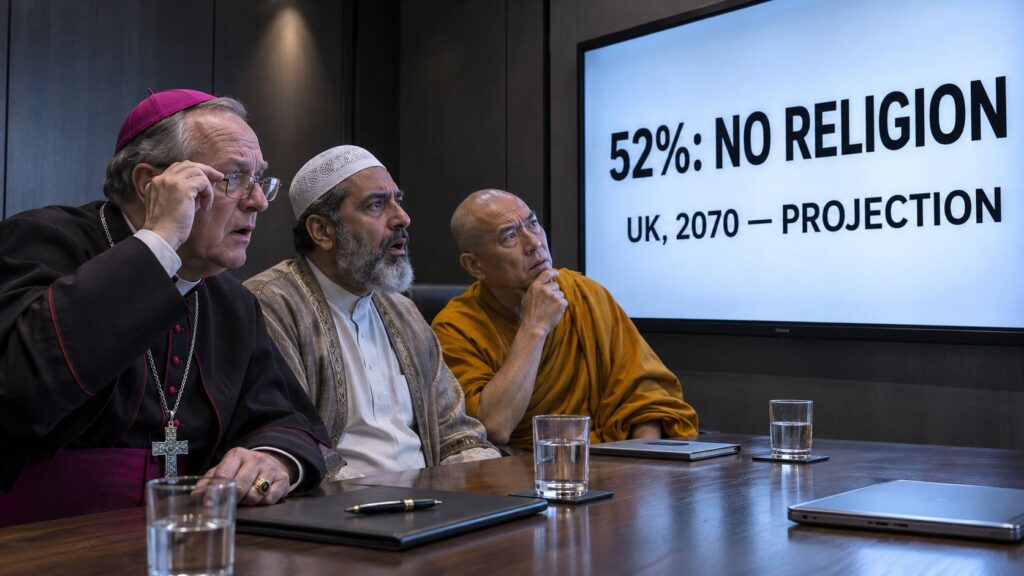
No religion. Soon the majority?
People with no religious affiliation are projected to become the majority in France, the United Kingdom, and South Korea by 2070. Across much of Europe and North America, religious identity is becoming less universal, and the assumption that almost everyone belongs to a faith is weakening.
Yet the global picture points in a different direction. Pew Research Center’s projections, published on November 18, suggest that the religiously unaffiliated will decline as a share of humanity. Understanding that apparent contradiction requires looking beyond church attendance and arguments about belief to population aging, births, deaths, and geography.
Where the nonreligious could become the majority
Under Pew’s main projection scenario, three countries would join those already recording unaffiliated majorities:
| Country | Projected religiously unaffiliated population in 2070 |
|---|---|
| South Korea | 60% |
| France | 53% |
| United Kingdom | 52% |
These figures describe people who identify with no religion. They do not mean that every person counted rejects all supernatural or spiritual beliefs.
Elsewhere in Europe, the changes would still be substantial without producing a nonreligious majority. By 2070, the unaffiliated are projected to account for 45% of Spain’s population and 40% of Germany’s. Christianity would fall below half the population in both countries.
Across Europe as a whole, the unaffiliated share is projected to rise from 25% in 2020 to 33% in 2070. National differences remain considerable: the projections anticipate declining unaffiliated shares in Albania, Russia, and Belarus. Europe’s religious future follows several different paths.
“No religion” covers many different outlooks
Pew’s category includes atheists, agnostics, and people who simply answer that they have no religion. Some maintain spiritual beliefs, participate in rituals, or believe in a higher power without identifying with a religious institution.
Religious affiliation therefore measures one aspect of a person’s worldview. It cannot establish how skeptical, scientifically informed, politically secular, or socially progressive that person is.
This distinction matters especially when comparing societies. Someone may reject organized religion while retaining beliefs associated with family traditions. Another may identify culturally with a religion while doubting its central teachings. A survey label cannot capture every combination of identity, belief, and practice.
Why the global share could shrink
Pew projects that the unaffiliated share of the world’s population will fall from approximately 24% in 2020 to 17% in 2070. Population growth in regions where religious affiliation is widespread helps explain the change.
China is particularly consequential because it contains most of the world’s religiously unaffiliated people. As its population ages and deaths increasingly outnumber births, its unaffiliated population is projected to fall from roughly 1.3 billion to around 900 million.
That decline is large enough to outweigh increases elsewhere. It should not be interpreted as evidence that hundreds of millions of Chinese people are converting to religion. Much of the projected change reflects a shrinking population.
The same arithmetic explains how a group can become more prominent in numerous countries while losing ground globally. Countries differ enormously in population size, and demographic growth is uneven. Counting how many countries move in one direction does not establish which direction the world total will take.
Births and age profiles shape religious populations
A population’s future depends partly on how many of its members are young, how many reach childbearing age, and how births compare with deaths.
For 2020–2025, Pew estimates a global fertility rate of approximately 1.3 children per woman among the religiously unaffiliated, compared with 2.5 among Christians and 3.1 among Muslims. These figures describe demographic patterns; they do not demonstrate that religious belief alone causes differences in family size.
Geography matters. Unaffiliated populations are heavily concentrated in East Asian societies with low fertility and older populations. Many religious populations are concentrated in younger, faster-growing societies.
The projections also allow fertility differences within countries to narrow over time. They do not assume that today’s differences remain fixed forever.
Leaving religion still makes a substantial difference
Demography does not make personal decisions irrelevant. Religious switching—identifying differently from how one was raised—is central to the projected growth of nonreligion in North America.
Pew projects that the unaffiliated will reach approximately 41% of the population in both the United States and Canada by 2070. In the United States, Christians would remain the largest religious category, at approximately 48%, while losing their majority.
A comparison illustrates the importance of disaffiliation. If religious switching stopped entirely, Pew’s model would put the unaffiliated at only 31% of North America’s population in 2070, compared with 41% when switching continues. The hypothetical scenario isolates the influence of people changing their religious identities; it is not a prediction that such changes will stop.
Projections have limits
The year 2070 remains decades away. These figures depend on assumptions about future fertility, migration, and religious switching.
Pew uses switching data from 112 countries and territories. Where reliable information is unavailable, the model generally assumes no switching. That is a practical modeling decision, not proof that nobody changes their beliefs in those places.
Political change, greater freedom to disclose disbelief, religious revival, or faster disaffiliation could alter the outcome. A projection explains what follows from specified assumptions. It cannot settle what future generations will believe.
Freedom should not depend on winning a majority
For freethinkers, growing nonreligious populations create opportunities to challenge the assumption that public life must revolve around religion. Schools, public ceremonies, and political institutions should accommodate people whose lives have no religious foundation.
But equal treatment should never depend on crossing the 50% threshold. Atheists deserve freedom of conscience where they are a small minority, just as religious people deserve it where most citizens are nonreligious.
Demographic change cannot establish whether a belief is true, nor can it guarantee a humane society. The stronger objective is a society in which people can question inherited ideas, change their convictions, and live openly without punishment or exclusion.