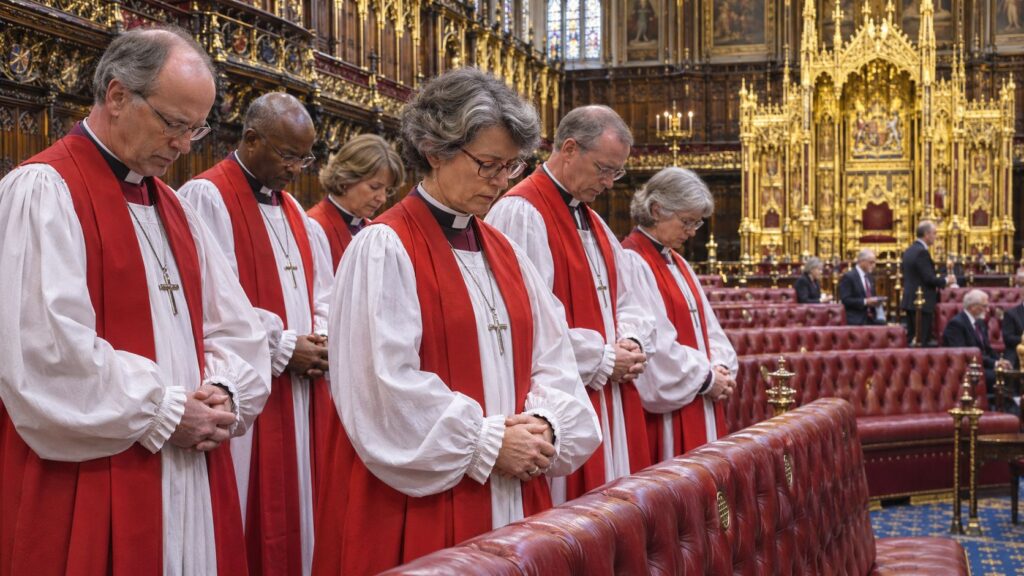
Britain: Why do bishops still get seats in Parliament?
In Britain, holding a senior position in the Church of England can come with an extraordinary privilege: a seat in Parliament and a vote on the laws everyone must obey.
The House of Lords reserves 26 places for Anglican archbishops and bishops, collectively known as the Lords Spiritual. Their seats come with their religious offices. No other religion—and no nonreligious worldview—enjoys an equivalent entitlement.
A church with parliamentary privileges
The arrangement reflects the Church of England’s established status and centuries of entanglement between religious and political authority. That explains how the system developed. It does not establish why it should continue.
During a House of Lords debate on November 10, peers challenged the arrangement and called for greater separation of church and state. Crossbench peer Lord Birt argued that privileging one church was incompatible with a country containing people of many faiths and none. Liberal Democrat Lord Purvis likewise opposed reserving legislative seats for clergy.
Bishops may bring experience, compassion, and valuable arguments to public debate. None of those qualities requires a guaranteed parliamentary seat. Teachers, nurses, scientists, social workers, and human rights advocates can make equally valuable contributions without enjoying an institutional entitlement to legislate.
Removing one discrimination leaves another intact
The debate concerned the Church Appointments (Repeal of Discriminatory Provision) Bill. It would remove historic restrictions preventing Roman Catholic and Jewish officeholders from advising the monarch on certain Church appointments or making those appointments themselves.
Ending those restrictions is a welcome reform. But the government explicitly described the bill as narrow: it would not reconsider the Church’s established status or change the constitutional relationship between church and state. The bishops’ reserved seats are therefore not being abolished by this legislation.
That leaves a larger question unanswered. Why should a religious institution receive guaranteed political representation in the first place?
Religious freedom does not require religious privilege
A secular Parliament would leave bishops free to speak, campaign, criticize government, and participate in public life. Removing their automatic seats would take away a special institutional advantage, not their freedom of religion.
The wider House of Lords also raises democratic questions because its other members are not elected. Ending bishops’ automatic membership would not resolve every problem with the chamber. It would, however, remove a particularly explicit form of religious favoritism.
People should be free to follow a church, leave it, or reject religion altogether. Their laws should not be shaped by parliamentary privileges reserved for the leadership of one denomination.