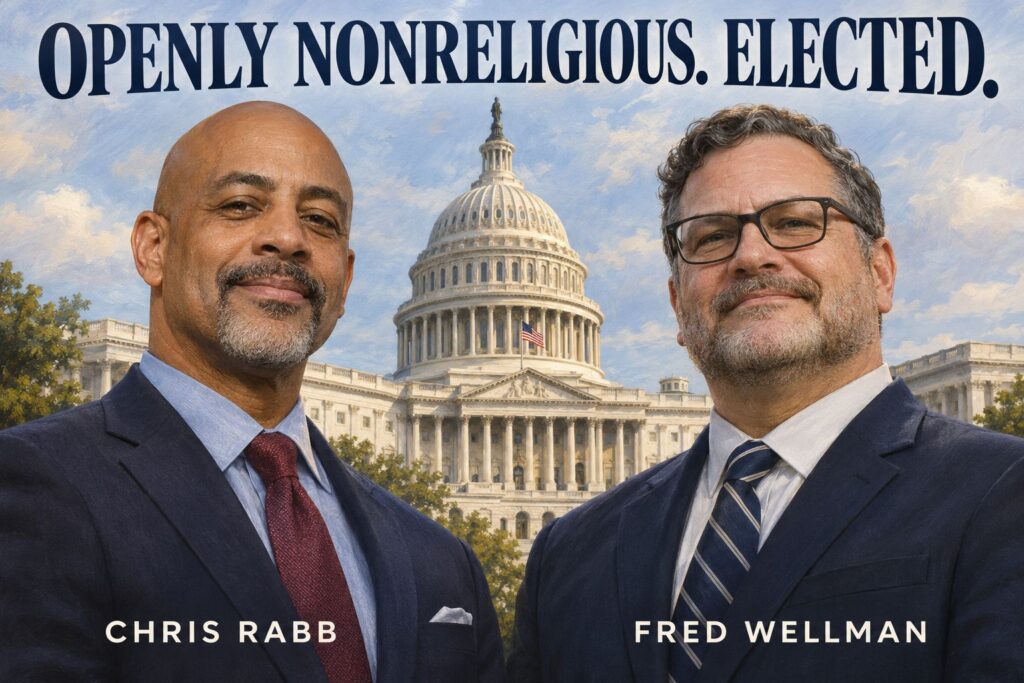
Openly nonreligious—and elected to Congress
Candidates should not have to profess religious faith to be considered trustworthy, patriotic, or fit for public office. Two victories in the November 3 U.S. elections offer an encouraging reminder that voters can look beyond that expectation.
Chris Rabb of Pennsylvania and Fred Wellman of Missouri won seats in the House of Representatives after campaigning as openly nonreligious candidates, according to the Center for Freethought Equality, the advocacy and political arm of the American Humanist Association. Both will enter Congress in January.
Two different paths to Washington
Rabb, a Pennsylvania state representative, won the race to succeed retiring Representative Dwight Evans in Philadelphia’s 3rd District. His campaign emphasized affordable housing, healthcare, and economic security.
Wellman, a retired Army officer and host of the On Democracy podcast, defeated seven-term Republican incumbent Ann Wagner in Missouri’s Republican-leaning 2nd District. His campaign focused on issues including workers’ rights, paid family leave, and healthcare access.
Their victories do not establish that voters supported them because they were nonreligious. Elections turn on many issues. They do demonstrate that openly identifying that way need not prevent a candidate from winning—even when challenging an established incumbent.
What makes the milestone different
The Center for Freethought Equality describes Rabb and Wellman as the first people elected to enter Congress already openly nonreligious. That claim needs a precise distinction: they are not the first members of Congress to publicly identify as nonbelievers.
Former Representative Pete Stark was an openly atheist member, and Representative Jared Huffman has publicly identified as a humanist. The distinction concerns openness before first entering Congress, rather than disclosure during an established congressional career.
That matters because visibility can change expectations. Every successful candidate who declines to perform religious devotion makes it harder to sustain the assumption that faith is a prerequisite for public service.
A growing presence beyond Congress
The gains extend to state government. In its November 5 assessment, the Center for Freethought Equality reported that its count of openly humanist, atheist, and other nonreligious state legislators and legislators-elect had risen above 100 across at least 38 states, compared with 81 legislators in 33 states before the election.
These are the organization’s figures, and its announcement noted that some election results remained unofficial or were still being counted.
The broader representation gap remains substantial. Pew Research Center’s 2023–24 Religious Landscape Study found that 29% of American adults identified as atheist, agnostic, or religiously unaffiliated. Its analysis of the Congress that began in January 2025 found that 87% of voting members identified as Christian.
Public service needs no religious test
Nonreligious politicians deserve the same scrutiny as anyone else. Their beliefs do not automatically make them competent, compassionate, or honest. Their records, policies, and conduct must establish those qualities.
But the same standard must apply to religious politicians. A declaration of faith is no substitute for integrity, and an absence of faith is no evidence of its absence.
For Freethinkers International, the significance is straightforward: people should be able to seek public office without concealing their convictions or inventing religious ones. A representative democracy becomes more credible when its citizens can recognize themselves among those entrusted to govern.