Latin America is moving away from Catholicism
Catholicism is losing its hold across much of Latin America. In countries long associated with the Church, smaller shares of adults identify as Catholic, while growing numbers describe themselves as atheist, agnostic, or without a particular religion.
Pew Research Center’s comparison of surveys from 2013–14 and 2024 found that Catholic identification fell by at least nine percentage points in each of six countries studied: Argentina, Brazil, Chile, Colombia, Mexico, and Peru. In Brazil and Chile, Catholics accounted for less than half of adults surveyed in 2024.
The change raises a question that goes beyond church attendance: how much authority should a religious institution retain in societies whose people increasingly choose different paths?
The numbers behind the decline
Pew’s report, published in January 2026, draws on interviews with 6,234 adults conducted in 2024. These figures describe religious identity at the time of the survey, rather than a live count of believers in 2026.
| Country | Catholic adults, 2024 | Religiously unaffiliated adults, 2024 |
|---|---|---|
| Argentina | 58% | 24% |
| Brazil | 46% | 15% |
| Chile | 46% | 33% |
| Colombia | 60% | 23% |
| Mexico | 67% | 20% |
| Peru | 67% | 12% |
Over approximately a decade, the unaffiliated share roughly doubled in Argentina, Brazil, and Chile; tripled in Mexico and Peru; and nearly quadrupled in Colombia. In Argentina, Catholic identification fell from 71% to 58%.
These changes do not mean Catholicism has disappeared. They mean its position as an inherited, widely shared identity is becoming less secure.
Younger generations are choosing differently
The generational gap is particularly revealing.
In Mexico, 59% of adults ages 18–34 identified as Catholic, compared with 77% of those ages 50 and older. In Colombia, 33% of adults under 35 were religiously unaffiliated, compared with 10% of those 50 and older. Across all six countries, younger adults were less likely to identify as Catholic.
An affiliation passed from parents to children cannot be assumed to last throughout adulthood. People may retain family traditions while reconsidering the institution behind them, or reject the religious identity in which they were raised altogether.
The age differences suggest a challenge for the Church’s future, although they cannot establish exactly how today’s younger adults will identify decades from now.
Leaving Catholicism does not always mean joining another church
The familiar explanation for Catholic decline emphasizes competition from evangelical and Pentecostal churches. That is part of the picture, but it does not account for every departure.
In four of the six countries, more former Catholics had become religiously unaffiliated than had switched to Protestantism. In Mexico, 15% of all adults were raised Catholic and subsequently became unaffiliated, compared with 4% who moved from Catholicism to Protestantism.
Brazil differed: 13% of all adults were former Catholics who became Protestant, while 7% were former Catholics who became unaffiliated.
For secular observers, the distinction matters. A transfer between churches changes the religious landscape. Leaving religious affiliation altogether opens a different set of possibilities—though it does not automatically produce skepticism or a secular political outlook.
Belief survives beyond the institution
Catholic decline should not be exaggerated into a claim that Latin America has become atheist. Around nine in ten or more adults in each surveyed country said they believed in God. Even among religiously unaffiliated respondents, majorities retained that belief.
Someone can reject Catholic membership while continuing to pray, believe in an afterlife, or pursue an individual spirituality. Religious identity, supernatural belief, and obedience to church authorities are separate questions.
For freethinkers, intellectual independence requires more than replacing one label with another. It involves examining claims, accepting uncertainty, and allowing evidence to challenge inherited convictions.
A papal visit against a changing backdrop
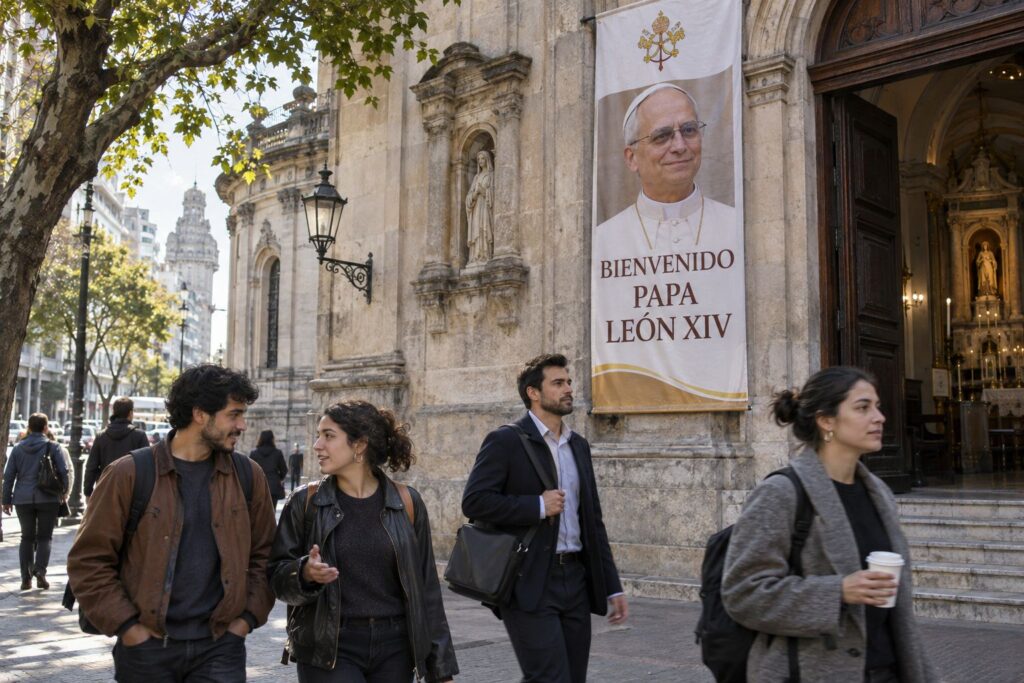
Pope Leo XIV began a South American tour in Uruguay on November 6, with Argentina and Peru also on the itinerary through November 17. His visit brings renewed attention to a region where Catholic affiliation has been declining.
Large crowds and enthusiastic receptions may demonstrate devotion among those who attend. They cannot, by themselves, establish that the broader demographic trend has reversed.
The more consequential story will continue after the papal ceremonies: whether people retain their childhood religion, change it, or decide they no longer need one.
Public rights cannot depend on religious membership
A declining Catholic share strengthens the practical case for governments to recognize religious diversity and nonbelief. But equal rights should never depend on a church losing its majority.
Education, healthcare, reproductive freedom, and equal treatment belong to individuals regardless of their religious affiliation. Catholics have the right to practice their faith; everyone else has an equal right to live without Catholic doctrine determining their choices.
The freedom to leave is part of freedom of conscience. Latin Americans who reconsider an inherited faith are exercising that freedom—and no institution is entitled to their lifelong allegiance.