China’s Potemkin prisons: Even the polished image reveals abuse
A “Potemkin village” is a façade designed to make reality look better than it is. The expression comes from the disputed story that Grigory Potemkin erected fake settlements to impress Catherine the Great during her 1787 journey through territories newly acquired by the Russian Empire. Whether or not the legend is accurate, the metaphor endures: show visitors an impressive exterior while keeping the unpleasant reality out of sight.
Clean corridors, landscaped grounds, classrooms, and a well-equipped infirmary: this was the prison China showed human-rights advocate John Kamm when he visited Yancheng, near Beijing, in February 2003.
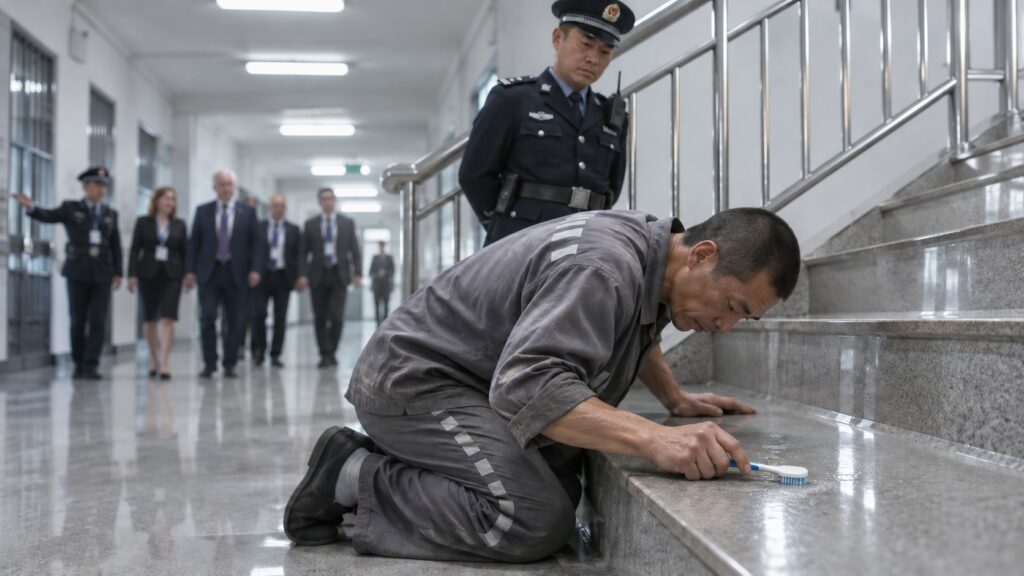
A former prisoner later gave him another perspective. Inmates dreaded visits by foreign dignitaries because of the work imposed to prepare the institution.
“We are given toothbrushes to clean the stairs and if any dirt remains we are punished,” the man told Kamm.
The contrast is revealing. Even the effort to display an orderly, humane prison reportedly involved coercion and punishment. The polished appearance concealed the conditions under which it had been produced.
A carefully selected view
Yancheng is a real prison, with real inmates. The “Potemkin” comparison concerns what selected visitors are shown—and what those visits cannot establish about the wider system.
In his account, published by the Dui Hua Foundation in 2019, Kamm described officials presenting Yancheng as a teaching institution where prison administrators would learn advanced methods. During his visit, he saw plentiful food, educational facilities, and carefully maintained grounds.
The South China Morning Post separately described Yancheng as a model facility visited by diplomats from numerous countries. Its relatively comfortable conditions and prominent inmates also earned it a reputation as a luxury prison. Yet the same reporting described pervasive electronic surveillance and official criticism of misconduct by guards. Attractive surroundings were hardly proof that prisoners’ rights were secure.
Model prisons for foreign visitors
The practice predates Yancheng.
Kamm recalled that, during a 1991 meeting, Ministry of Justice officials told him China welcomed foreigners to thirty-one model prisons. More than 20,000 foreign visitors had reportedly toured such institutions since 1979. At the same meeting, officials said they were not prepared to permit International Committee of the Red Cross prison visits.
Kamm questioned whether model facilities represented ordinary conditions. He asked to visit an institution that was not a model prison and had never received a foreign visitor. The authorities eventually arranged a visit to Meizhou Prison. His account demonstrates both the existence of a curated system and the importance of pushing beyond it.
A government-selected tour cannot answer the questions an independent inspection should ask. Can visitors choose whom to interview? Can prisoners speak privately without fearing retaliation? Can investigators enter areas officials would prefer to keep closed?
Without those protections, a clean corridor tells visitors little about what happens after they leave.
When the scenery was literally rearranged
An especially explicit example appears in a 1994 report by Human Rights Watch/Asia and Human Rights in China.
According to the report, authorities prepared Beijing No. 2 Prison for a proposed Red Cross visit by moving sick prisoners and those considered visually unsuitable away from the intended route. Improved menus were displayed, while new bedding was laid out that prisoners were forbidden to use.
Selected inmates were instructed to appear to be taking showers during the visit. Occupied blocks were to be described as unused. Production work was halted, materials concealed, and punishment cells temporarily emptied.
The visit was canceled. Prisoners were then returned to the punishment cells.
These are historical allegations documented in a report published in May 1994, not a description of a recent inspection. Their significance is the detailed account of how authorities allegedly manufactured an appearance of humane treatment while concealing ordinary conditions.
Beyond the tour route
Evidence of torture in China’s wider prison and detention system extends well beyond political dissidents.
Human Rights Watch’s 2015 investigation, Tiger Chairs and Cell Bosses, examined court judgments and drew on interviews with forty-eight former detainees, relatives, lawyers, and former officials. It documented beatings, suspension by the wrists, prolonged sleep deprivation, painful restraint, and violence by detainees acting as informal cell enforcers.
Most suspects whose torture complaints the investigation examined had been accused of ordinary crimes, including theft. Much of this evidence concerned police interrogation and pretrial detention—a distinction that matters when discussing the broader system.
More recent reporting shows that the concern has not disappeared. Human Rights Watch’s World Report 2026 describes continuing torture of human-rights defenders. It also cites a UN expert’s 2025 concerns about allegations of torture, inadequate medical care, and restrictions on visits to imprisoned defenders.
Human rights must survive the visitors’ departure
None of this establishes that every Chinese prison has identical conditions or that every prisoner is tortured. It establishes why selected institutions and supervised visits cannot substantiate broad claims of humane treatment.
Better food, medical facilities, and living conditions matter. Every prisoner should have them. But their value as evidence depends on whether they reflect ordinary treatment, extend to all prisoners, and coexist with protection from coercion and violence.
The former Yancheng prisoner’s account captures the problem with unusual clarity: even a spotless staircase can conceal an abusive demand.
A prison system should be judged by how it treats people when nobody important is watching.