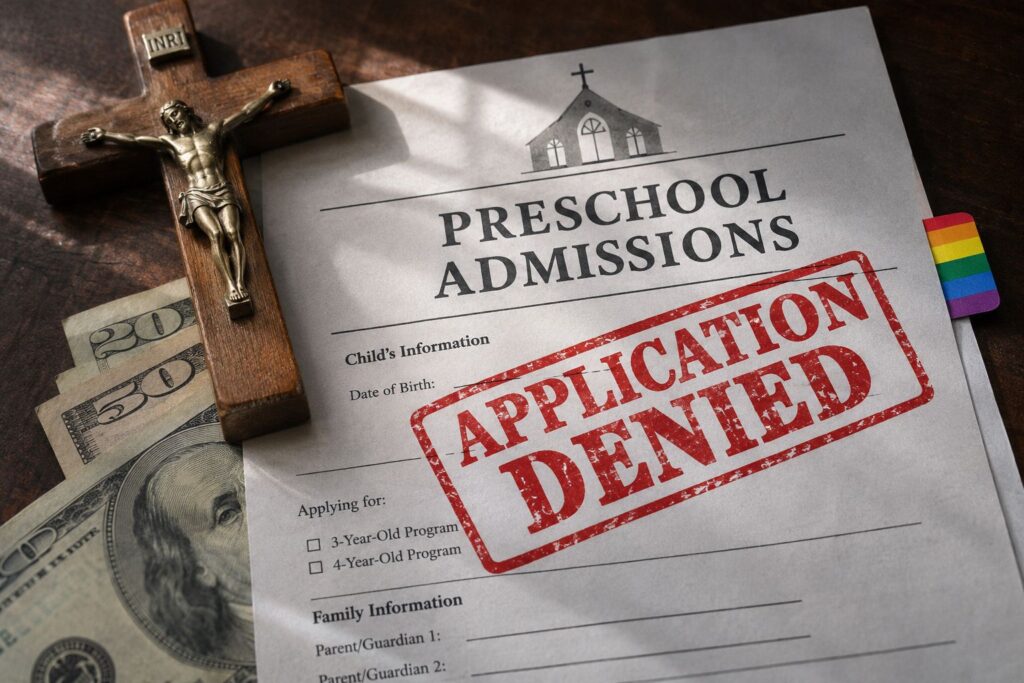
Public money, religious discrimination?
Should a preschool receive taxpayer funding while reserving the right to reject a child because their parents are a same-sex couple?
That question is at the heart of St. Mary Catholic Parish v. Roy, which the U.S. Supreme Court heard on November 3. Catholic institutions are challenging Colorado’s refusal to exempt them from LGBTQ nondiscrimination requirements in its publicly funded preschool program. The Trump administration supports their challenge. No ruling has been issued.
The dispute concerns more than access to preschool. It asks how far religious exemptions should extend when institutions seek public money—and who bears the consequences when those exemptions permit discrimination.
What Colorado requires
Colorado’s universal preschool program provides up to 15 hours of tuition-free preschool each week during the year before kindergarten. Participating providers must offer equal enrollment opportunities regardless of protected characteristics, including sexual orientation, gender identity, and religious affiliation.
Religious schools can participate. The disagreement concerns whether Catholic providers must comply with the same admissions protections while receiving public support.
The Tenth Circuit upheld Colorado’s requirements, finding them neutral and generally applicable. The Supreme Court is now reviewing that conclusion.
For families, the practical issue is straightforward: whether a publicly supported preschool can turn away their child because it disapproves of their family.
The schools’ argument
The Catholic institutions say their admissions policies are part of their religious mission. They require families to support Church teachings, including those concerning marriage, sexuality, and gender. Their argument is that conditioning financial assistance on abandoning those practices burdens religious freedom.
They also challenge Colorado’s claim that its rules apply equally. The schools point to permitted enrollment preferences and argue that the state accommodates secular priorities while refusing comparable religious accommodations. Colorado disputes that comparison, maintaining that those preferences advance access rather than authorize the discrimination the schools seek to permit.
This distinction matters. A fair account must address the schools’ actual claim of unequal treatment. It must also examine whether prioritizing underserved children is meaningfully comparable to excluding children because their parents are gay.
Can families simply go elsewhere?
During oral arguments, Justice Brett Kavanaugh questioned why Colorado could not accommodate the Catholic schools while LGBTQ families used other participating providers.
Colorado’s lawyer, Helen Norton, explained why that answer is inadequate: a suitable preschool may be the one near a family’s home, the one with workable opening hours, or the one able to accommodate siblings. Another available school is not necessarily an equivalent option.
Justice Sonia Sotomayor pressed the schools’ lawyer on whether their position would permit rejecting a child simply because their parents are a same-sex couple. He indicated that it could, where the decision reflected sincere religious exercise.
The existence of another school does not remove the rejection. Nor does it erase the message conveyed when a publicly funded institution treats a child’s family as unacceptable.
Religious freedom and equal treatment
Religious freedom protects beliefs that others consider mistaken, offensive, or harmful. Protecting that freedom does not require agreement with Catholic teachings on sexuality.
But the question here extends beyond the freedom to hold and teach those beliefs. It concerns the conditions attached to participation in a publicly financed service.
Lambda Legal and GLAD Law, which support Colorado’s position, argue that nondiscrimination requirements help ensure that publicly funded preschool programs remain accessible to all families. They oppose making it easier for religious providers to opt out of those protections.
From a secular human-rights perspective, public funding should carry a clear obligation to treat families equally. Otherwise, taxpayers—including LGBTQ taxpayers—can be required to support institutions that would reject their own children.
The decision is still ahead
Several conservative justices appeared sympathetic to the Catholic institutions during the hearing. That is an indication of their concerns, not a final judgment. A decision is expected by the end of June.
The Court’s eventual reasoning could influence how governments attach nondiscrimination conditions to other publicly supported services.
For the children involved, however, the issue is less abstract. Their access to a taxpayer-funded preschool should not depend on whether its religious administrators approve of their parents.